
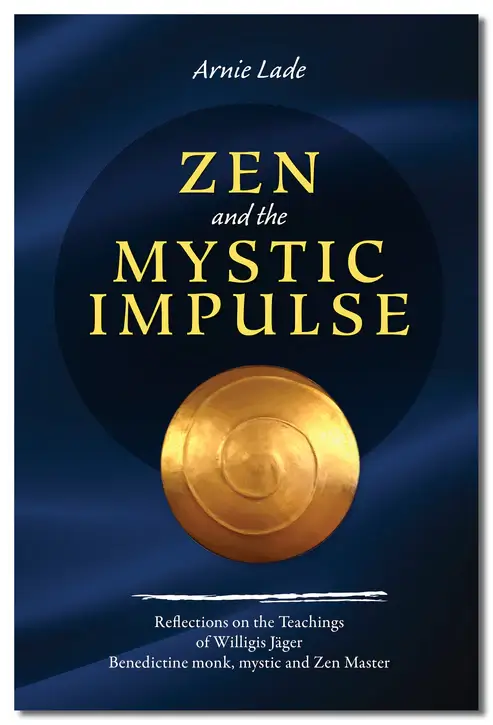
Zen and The Mystic Impulse by Arnie Lade
Charles Joerin, Victoria, BC
Volume 41 Issue 1,2,&3 | Posted: April 8, 2026
Introduction
The theme of Arnie’s book is encapsulated in its very title: being human is to have an innate desire, or impulse, to know the ineffable, that which lies behind the surface layers of all that we see with the “outer eye”.
Arnie expresses himself thus in Chapter 1:
In the depth of my being, there has always been a sense, a knowing, that there is something More, a Presence, something much greater than myself to which I am intimately connected.1
Full Disclosure
I have known Arnie Lade for twenty years, first as an acupuncturist, then as a friend, a fellow seeker of that which is unchanging AND accessible to all. So, yes, I may be biased in my praise of his book, but so be it. What you read here in this review, however, are my true reflections and assessment of the book.
Arnie shares his personal journey, filled with wonder, in this book. Truth be told, I hope for a future memoir that expands on his story and reflections begun in this book. Certainly, his road includes meeting the man he honours in the subtitle, Willigis Jäger, Benedictine Monk, Mystic and Zen Master.
I also note my friendship with the author, so you know you are reading a book written by a brother to us all, who treads a similar path. This, coupled with a style that immediately draws the reader into an almost familial relationship with the author, who, like us, is flawed and heroic, all wrapped up in the same person, makes for a swift uptake in wanting to read on.
In Arnie’s book, Zen and the Mystic Impulse, we are introduced to a ‘way in’ to recognizing the ‘More’ in our own lives. Many of us may already do so, and it is delightful to connect with what he says and to find ourselves responding, “Yes, that’s my experience too”. And if not, there is a kind and welcoming invitation to our own explorations.
I am reminded of the Christian scripture in which two unnamed disciples are walking on the road to Emmaus and encounter a person who walks with them and explains recent events in Jerusalem concerning Jesus of Nazareth. Upon arriving at Emmaus, the disciples ask the person to break bread with them, which he does. At this point in the story, the person is recognized as the same Jesus who was crucified:
Were not our hearts burning within us while he talked with us on the road and opened the scriptures to us?2
I like to think we have all experienced something like this, perhaps from a particular teacher at school, later from a friend, a spouse, a leader of a particular religion, or a great work of art. Like me, I think that Arnie Lade’s reflections and connections, written in this book, will, if not have your hearts burning, give you pause and perhaps some AHA! moments where things ring true for you because they make perfect sense and are so respectfully and humbly presented. Presented not to push any particular religion but to create the space where all are welcome, because we are all on the same road as the Emmaus disciples, possessed by the “mystic impulse” to connect to the ineffable, the never fully knowable ‘Other’.
A word about Zen might be appropriate since it is featured in the title of Arnie Lade’s book. Here he elaborates:
In Zen, this spiritual quest is called taking up the Great Matter of birth and death. This journey leads through the encounter of our most profound personal koans or questions at the crucible of all the paradoxes and dilemmas in one’s life, the ones that cannot be answered rationally…the answers lie in a transcendent experience – an experience that emerges spontaneously, that, by nature, is beyond the conditioned, rational self, out of which new perspectives and meanings emerge. In doing so, we can come to terms with life as it has been given to us in this existence, this place, and time. p17
Although Arnie employs Zen as the lens for his thesis, he by no means excludes others. In fact, one of the most appealing aspects of this book is that he encourages the reader to use their own lens, their own spiritual and religious vocabulary, to explain what is transpersonal, beyond any human construct. The author employs quotations from different traditions to make this point. The Mystic Impulse simply IS within us and therefore deeper than any allegiances we might have through life.
The subtitle of Zen and the Mystic Impulse is: Reflections on the Teachings of Willigis Jäger, Benedictine monk, mystic and Zen Master. Who was Willigis Jäger, and who was he to Arnie Lade? This is very much integrated into the book, although Arnie includes a short biography of Willigis Jäger in Appendix 1. In Arnie Lade’s Afterwords, he notes:
A quarter century ago, Willigis wrote,“Fundamental transformation of the world will never be achieved by a new social system, but only through the transformation of the individual … p117
I would conclude (and the book confirms) that Willigis was one of those who had a profound influence on Arnie’s transformation, which began many years before Arnie ever met Willigis. But this is how life is, is it not? If we are open to the spirit of transformation, people and events are offered to us, and when we take them seriously, we are transformed.
Conclusion
Let us conclude with a quote that honours the inclusivity found in both Willigis Jäger and the author, Arnie Lade, and that gives us an image we can carry with us on our own journeys of transformation:
One of Willigis’s frequently used analogies in describing the varieties of spiritual and religious experience throughout human history is that of light shining through stained glass, such as in a church. The pure sunlight diffuses and, at the same time, is tinted and tainted by the various colours, images and forms through the glass. Similarly, in mystical experiences, the individual expresses the one transcendent light (or reality) through their lived experience using words, images, songs and other unique intimations of their personality and conditioning. This conveys the inexpressible joy of breaking through into a whole new awareness. p17
Afterword:
I was active as a Roman Catholic priest on Vancouver Island for 12 years and am now retired. As a pre-teen, I lay in my bed asking, “Why am I here, rather than not here?” Truly, my life’s koan, the answer to which I get glimpses. An example was during Mass, when I gave the blessed bread and said “the body of Christ” to my parishioners. I felt something more than an emotion; it was an awareness that, as I gave the bread to each person, knowing much of their joys and sorrows, we were all truly one mystical body on the same journey, longing to know the answer to the same question I had asked myself so long ago. And yet today I do not have such a burning need to know the answer, but I do claim the mystical impulse to answer the answerable. And in the end, perhaps that is enough, simply to respond to the call of that perennial impulse propelling us into the mystic. I think this is the nub of what Arnie Lade is saying in this book.
And Finally:
A few words from Meister Eckhart, a 14th-century Dominican theologian whom some consider a mystic and who is read and referenced on several pages in Arnie Lade’s book. Here, on p. 116, the last page before Arnie’s Afterwords:
The most important hour is always the present moment, the most important person is always the one who is facing you right now, and the most necessary work is always love.3
I heartily recommend this book to you. You will wish to read it more than once, drawn by the author’s sense that you are the most important person in this moment. I think he wrote it as an act of love and respect, not only for his great teacher Willigis but also for you, the reader.
Zen and Mystic Impulse by Arnie Lade is available at local bookstores.
Footnotes
1 p.13 Zen and the Mystic Impulse. 2025
2 Luke 24:32 New International Version
3 Maria Kolek Braun Im Gesprach Seen (Holzkirchen, DE: Benediktushof Magazin-Online-Artikel) Internet source: https//www.benediktushof-holzkirchen.de/im-gespraech-sein/
Charles Joerin, Victoria, BC