
Carney: Scale and Speed: Not Rights and Obligations, nor Solidarity and Citizenship
Bhagwant Sandu
Volume 41 Issue 7, 8, & 9 | Posted: October 5, 2026
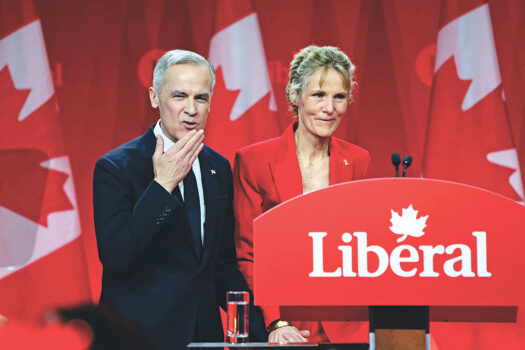
OTTAWA—Buried inside Prime Minister Mark Carney’s press release ahead of his May 27 trip to New York is a sentence Canadians should pay more attention to than the usual language about resilience, growth, or investment: “We are building at scale and speed.”
It sounds like ordinary political boilerplate. It is not. It is perhaps the clearest expression yet of the governing philosophy in Ottawa, one that’s visible in the federal push to accelerate major project approvals, expand defence procurement, and scale public investment in artificial intelligence.
Scale and speed. Not rights and obligations. Not solidarity and citizenship. Scale and speed.
Political systems eventually become reflections of the values embedded in their vocabulary. And the vocabulary surrounding this government is managerial rather than democratic. It speaks less in the language of citizenship than in the grammar of pipelines and productivity.
To be sure, this is not the neoliberalism of the 1990s when governments retreated from markets through privatization and austerity measures. Carney’s project depends on something different; an active state that intervenes in capital formation. It does that through production subsidies, tax incentives, and co-ordinated public-private financing structures.
Government is back. But back for whom? That is the question beneath Carney’s visit to Wall Street.
Carney is not alone. Across the world, industrial strategy has returned as a central instrument of statecraft. In Canada, it is shaped by external constraints: supply chain fragmentation and overt protectionism under Canada-United States-Mexico-Agreement-adjacent conditions. Disengagement is not a realistic option.
But adaptation carries consequences: citizens increasingly become economic units.
You can feel the psychological effects of this shift. Young people are discussed less in terms of building stable lives than labour-market attachment. Housing is discussed less as shelter than affordability metrics. Health-care debates revolve around sustainability curves. Childcare becomes workforce participation policy. More and more, social programs are expected to justify themselves in productivity terms before they are justified in democratic ones.
If Prime Minister Mark Carney speaks to Wall Street about scale and speed, he must do the same for domestic social security, writes Bhagwant Sandhu.
Social-policy debates collapse into a single question: how does this improve Canada’s competitiveness?
That should concern Canadians far more than it does.
This is the paradox facing Carney. The same state mobilizing billions of dollars for electric-vehicle battery plants and supply chains remains cautious on universal social programs like pharmacare, which has now been stalled. Competitiveness comes first. Universality, if it arrives, comes second.
None of this occurs in a vacuum. Carney’s background in central banking and climate-risk governance reflects a broader turn toward managerial capitalism, accepting market instability and responding through state co-ordination. It strengthens capacity without strengthening social cohesion. Industrial policy is scaled while households face food insecurity.
A more capable state is not necessarily a more equitable one. It can widen the gap between what governments do for capital formation, and what they do for social protections. That gap is where political friction accumulates. As it stands, Ottawa can fast-track project approvals and suspend regulatory obstacles in the name of economic urgency while Canadians remain on waiting lists for years to see a family doctor. If governments can move quickly for investment attraction but not for housing, health care, or income security, then institutional legitimacy erodes.
The system frays first in perception, not collapse.
Slim majority governments like Carney’s may have been given room to act on foreign direct investment at scale, but that latitude is politically fragile. It can shift suddenly if voters conclude that the balance between economic responsiveness and social protection has tilted too far.
The Conservatives understand this instinctively. Their appeal rests less on an alternative economic model than on a diagnosis of distrust: that the Liberals are no longer oriented toward ordinary citizens. But this only reflects an existing perception; it does not resolve it. The NDP, under Avi Lewis, faces a different test: whether it can defend a politics where social obligation is not subordinated to economic metrics, or whether it accepts efficiency as the limit of political possibility. Lewis has shown a willingness to revisit ideas once dismissed as unrealistic, including proposals for a public grocery retailer to counter concentrated corporate power. (see article, “A Bagful of Reasons to Create Public Grocers under the “Other Features” tab)
If Carney speaks to Wall Street about scale and speed, he must do the same for domestic social security. Otherwise the message splits: government moves quickly for capital, not so quickly for households. The divide is already visible: multibillion-dollar financing for battery plants with an incomplete pharmacare rollout; strong state support for private-sector risk in oil and gas but next to no commitments to employment insurance or income stabilization measures.
If left unresolved, these imbalances could harden into political perception. Voters may begin to suspect that the government still moves at scale and speed—just not for them.
Bhagwant Sandhu is a retired director general from the federal public service. He has also held executive positions with the governments of Ontario and British Columbia. Mr Sandhu writes for The Hill Times
Bhagwant Sandu