
Catholic Worker Founder Peter Maurin
Phil Little, Ladysmith, BC
Volume 41 Issue 4, 5 & 6 | Posted: June 3, 2026
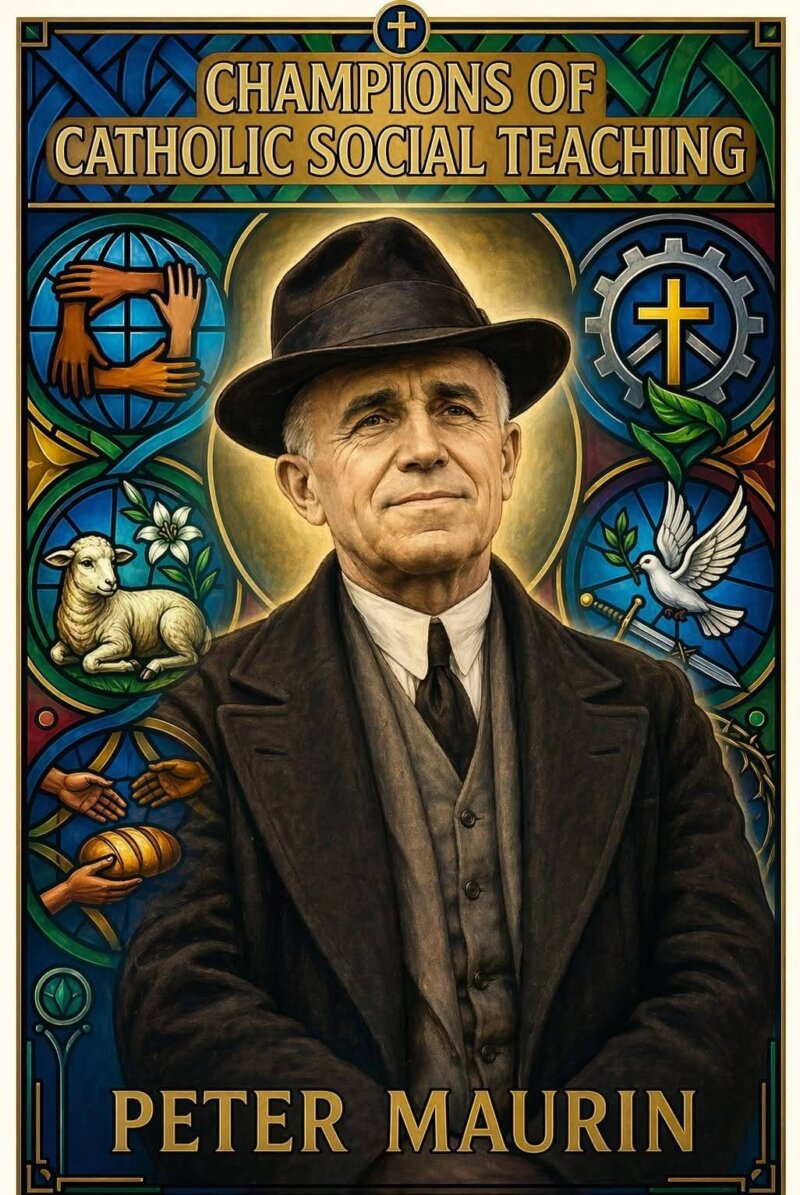
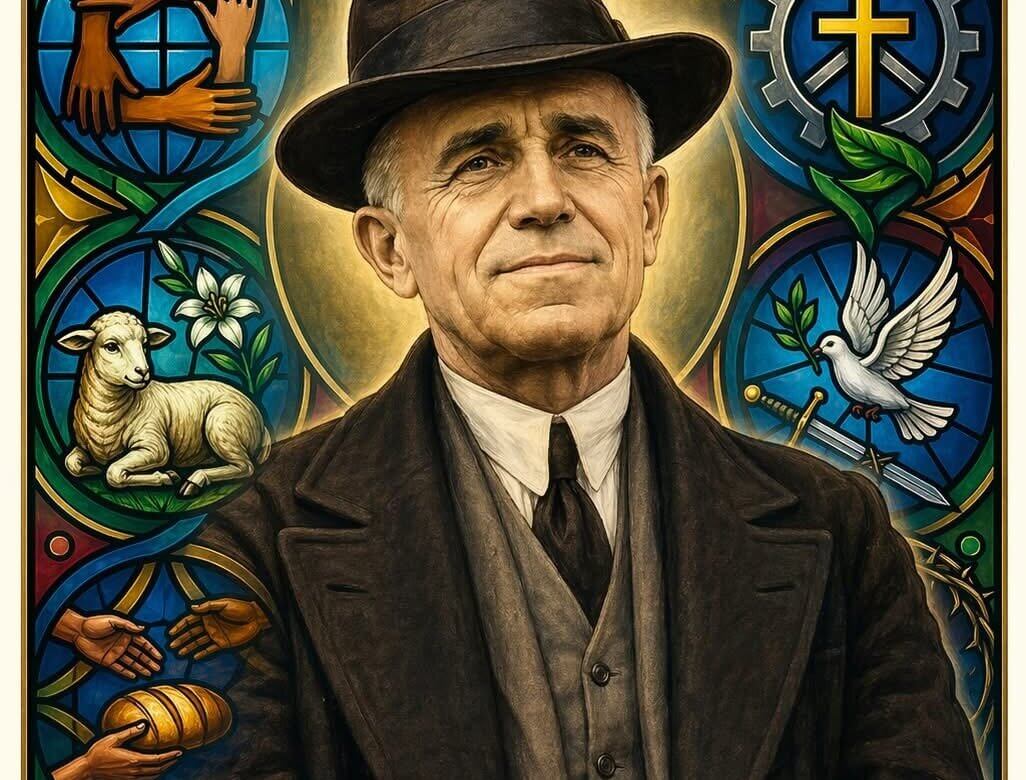
Peter Maurin (1877-1949) arrived in New York in 1909 with a peasant’s hands, a scholar’s intellect, and a vision of social order he had absorbed from the encyclical tradition and the French personalists.
Born in 1877 in the Languedoc village of Oultet, raised in a family that traced its tenancy on the same land back several centuries, he carried into the twentieth century a Catholicism rooted in soil, manual labor, and the corporal works of mercy.
When he met 35-year-old Dorothy Day December 1932 – who had been received into the Catholic Church just five years earlier – and proposed the program that became the Catholic Worker Movement, he was already a fully formed teacher of the Church’s social doctrine. Day herself never tired of insisting that Maurin was the founder, the philosopher, the indispensable mind behind what the world would later credit largely to her.
To read his Easy Essays today is to encounter Catholic Social Teaching translated from Latin encyclicals into the cadences of street-corner catechesis.
Maurin’s three-point program—roundtable discussions for the clarification of thought, houses of hospitality for the practice of the works of mercy, and agronomic universities where workers and scholars would labor and learn together—drew its substance from Rerum Novarum and Quadragesimo Anno and channeled the personalism of Emmanuel Mounier and the Christian humanism of Jacques Maritain.
He understood Leo XIII’s defense of the dignity of labor as a summons to make the parish and the farm into schools of that dignity. He understood Pius XI’s principle of subsidiarity as a mandate for small communities of welcome rather than for state bureaucracies of relief.
In the first centuries of Christianity, Maurin wrote, “the hungry were fed at a personal sacrifice, the naked were clothed at a personal sacrifice, the homeless were sheltered at a personal sacrifice. … In our own day the poor are no longer fed, clothed, and sheltered at a personal sacrifice, but at the expense of the taxpayers.”
The houses of hospitality he envisioned, and which Day brought into being on Mott Street and elsewhere, embodied what John Paul II would later call the preferential option for the poor decades before that phrase entered the magisterium’s working vocabulary.
What distinguishes Maurin from other twentieth-century Catholic social thinkers is his refusal to separate the intellectual from the manual, the contemplative from the active, the theological from the agrarian.
He insisted that the bishop’s study and the migrant worker’s field belonged to one continuous economy of grace, condensed in his triad “Cult, Culture, and Cultivation”—liturgy, literature, and agriculture cohering as a single Christian formation.
His call for a society where it is “easier for people to be good” was a synthesis of Aquinas on the common good, the Fathers on almsgiving as restitution rather than charity, and the Catholic agrarian tradition that ran from the Benedictines through G. K. Chesterton and Hilaire Belloc.
“The scholars must become workers,” he wrote, “so the workers may be scholars,” because he believed the wound between hand and head was the wound from which industrial modernity bled. And he framed the alternative with characteristic compression: “The world would become better off if people tried to become better. And people would become better if they stopped trying to become better off.”
Maurin died in 1949, having spent his last years in growing silence, sometimes mistaken by visitors for an unlettered farmhand at the Catholic Worker farm at Easton. The cause for his canonization, opened by the Archdiocese of New York alongside Dorothy Day’s, recognizes what those who lived with him already knew: that here was a layman who taught the Church’s social doctrine by living it, who fed the hungry while explaining why the hungry must be fed, who refused the dichotomy between orthodoxy and orthopraxy that has hobbled so much American Catholic witness.
In an ecclesial moment when Pope Leo XIV calls us back to the foundational vocabulary of work, dignity, and the common destination of goods, Peter Maurin remains a teacher whose Easy Essays still belong in the hands of every catechist, every social-justice committee, every Catholic Worker volunteer who wonders what the tradition actually requires.
Like Pope Leo XIV, Phil Little served as a missionary in Peru.
Phil Little, Ladysmith, BC