A Year of Leo – Modelling Synodality
Michael Higgins
(Excerpted from the May 9, 2026 edition of The Globe and Mail)
Volume 41 Issue 4, 5 & 6 | Posted: June 3, 2026
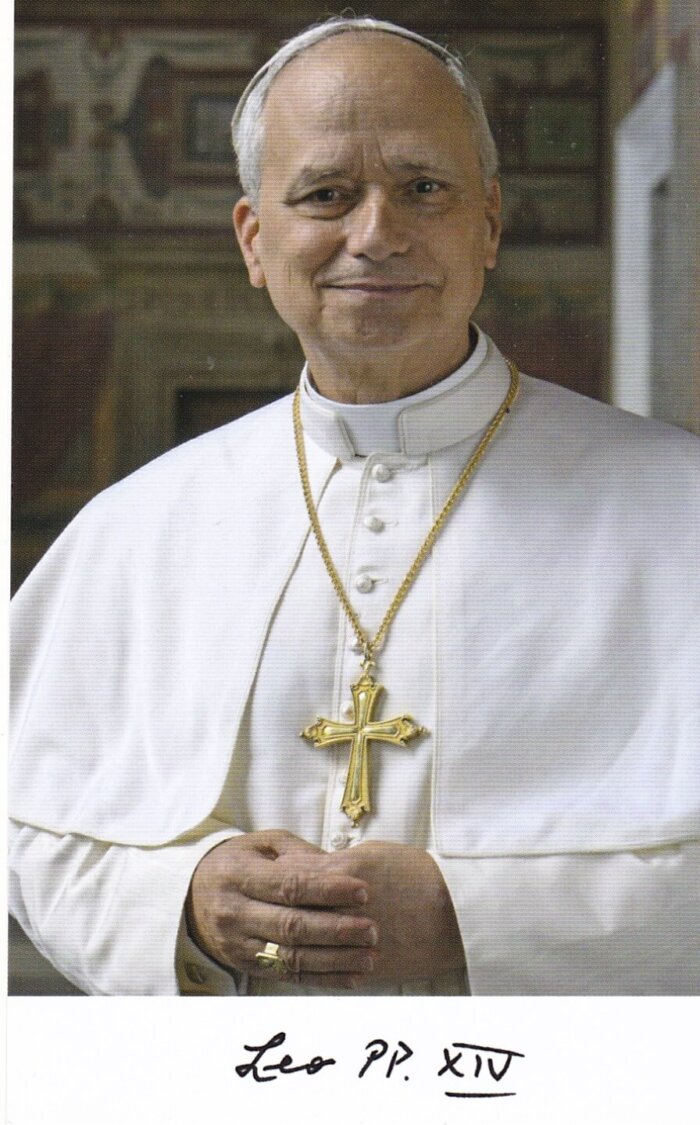
The first words of a new pope spoken from the Loggia delle Benedizioni or Balcony of Blessings following his election are significant. They reveal the tone and direction of the new Bishop of Rome.
Francis said good evening and asked the assembled throngs in the Piazza di San Pietro to pray for him.
And so when the American (and Latin American as he reminds us) Cardinal Robert Prevost of Chicago via Chiclayo (Peru), now known as Leo XIV, chose as his first words: “La pace sia con tutti voi.” (Peace be with you all) he was signalling more than a conventional pious sentiment.
He also said that this very peace is “unarmed and disarming, humble and persevering.”
How prescient that would prove to be in the coming months. Although Leo was speaking of the peace that is more than the cessation of violence, more than an end to adversarial war-mongering, he would find himself before the first anniversary of his pontificate fully embroiled with a truculent and bellicose fellow citizen: Donald Trump.
The collision between the two Americans atop the political and religious food chain was inevitable given their personalities. Pope Leo was appalled by the U.S. Administration’s migrants policy, the curtailing of religious practice for the undocumented, the flourishing of containment camps, the ruthless and illegal prosecution of wars, and the toxicity injected into public discourse, often invoking God in the process. He also managed to get the American bishops onside in a way that eluded his predecessor.
President Trump revels in an environment of no-holds-bar contestation, delights in vilifying and humiliating his opponents, refuses to apologize, and is unconstrained by decorum or simple human decency.
Mr. Trump’s approach is to bully and intimidate and Pope Leo’s is the living negation of that approach. As the American Jesuit ethicist James F. Keenan notes, the pope is emerging as a leader who exemplifies the virtues of a leadership of vulnerability, which does not mean primarily “having been wounded. It means, rather, being capable of being wounded by others.” In that sense the Vicar of Christ, the pope, takes the high road, exhibits personal courage and eschews retaliation. As Pope Leo said: “I’m not afraid of the Trump administration or of speaking out loudly about the message of the Gospel, which is what the church works for.”
Popes are not known for naming those whose policies call out for a public response. They couch their language in a code of indirection and in so doing argue that their neutrality must be preserved, so it is surprising that Pope Leo directly mentions the Trump Administration.
It was following a troika of Pope Francis-friendly American cardinals on CBS’s 60 Minutes however that prompted the presidential spasm of outrage. The gloves were off. Time to go for the cardinals’ boss.
Pope Leo, the cautious, reserved canon lawyer with a taste for the methodical and the irenic, was now the centre of global attention.
Although many church officials and Vatican commentators were quick to dissociate Leo from any political stance—he was after all only doing his job proclaiming the Gospel—the fact is that he was acting politically as indeed many of his predecessors did in the past. John Paul II had no hesitation in hastening the end of the Soviet Union and John XXIII played a critical backroom mediating role in the resolution of the Cuban Missile Crisis. When you take a strong moral stance and advocate on behalf of the oppressed you are being political; and as Helen Ghosh, Master of Balliol College, Oxford University, observes “engagement with the world is part of being a twenty-first century Christian, and there is no such thing as politics without religion.”
So Leo was thrust into the heart of it, not that he was ill-equipped to handle the imbroglio or unfamiliar with political chicanery and corruption. After all, his years as a missionary priest and then as a bishop in Peru schooled him in how to deal with conniving bishops and despotic rulers.
Trump was just a bigger player with higher stakes.
It is critical to resist the temptation to reduce Leo’s first year as pope to his full-on spat with Mr. Trump because there were many other things that unfolded that need to be considered in any fair assessment of his pontificate.
Although his predecessor was a Jesuit—another major precedent in papal history—Francis simplified the trappings of office, humanized the public face of the papacy, and lived not in the Apostolic Palace but in the Santa Marta, a Vatican apartment complex where he would regularly dine and chat with staff and visitors.
The Augustinian friar-turned-pope lives an ordered and regulated life punctuated by prayer, communal habitation—in a marked departure from pontifical protocol he lives with a community of Augustinian friars in rejigged papal quarters—and adheres to the conventions, theological dispositions, and pious practices of his religious order. He remains in every respect a son of St. Augustine and this is part of his strong appeal to the wider clerical brotherhood: he understands them, he nurtures them pastorally, he affirms their vocation.
Leo’s commitment as Bishop of Rome to work toward the twin pillars of peace and unity has both ad intra (internal) and ad extra (external) dimensions. In other words, his attention and energy must be marshalled to serve the cause of peace and unity both in the church he heads as the Successor of St. Peter and in the world outside the Catholic enclosure—the world full of hate-filled tyrants, bomb-loving belligerents, and economic titans.
Hence, the comprehensive coverage of his addresses and press interviews especially by American media. Taking on the Trump Administration’s extralegal war prosecution is one thing but taking on the Republic’s unmitigated commitment to laissez faire capitalism will be a bigger risk. Since 1891 with the publication of Reurm novarum by Leo XIII, the popes have been consistent critics of the economic inequality that is the by-product of unfettered capital markets.
With many prominent MAGA-friendly Catholic plutocrats with a history of deep distrust of the papacy of Francis wary about the direction to be taken in the political-economic order by an American pope, all interested parties are waiting for Leo’s first social encyclical to peruse, parse and parry. Such an encyclical is in fact imminent and the focus is on Artificial Intelligence. Unregulated AI not only threatens human self-definition, societal relations, and global interactions but it has also profound economic implications. As he said in his address on World Communications Day (January 24, 2026): “We are not a species made up of biochemical algorithms, defined in advance. Each of us has in us an irreplaceable and inimitable vocation that emerges through life and is manifested precisely in communication with others.”
Pope Leo XIV is as concerned about full-throttle AI as Leo XIII was with unconstrained free reign capitalism in late 19th century industrial Europe. Damage done to the human sensorium and to social cohesion is immense, but the potentiality for good seemingly inexhaustible. Leo walks the tricky tightrope of being a humanist without being a Luddite, a visionary without being a Cassandra.
But the ad intra challenges are just as demanding. They will take him into the fractious arena of the altar wars wherein Catholics compete over liturgical priorities, and they will take him into the unsettled territory of synodality, the great project of Pope Francis which Leo has pledged to continue. The question is how, in what manner, and at what cost? (see Lead Story entitled “Synodality: The Sound of a Tree Falling in the Forest?)
For Francis, synodality was a portal for reform and for Leo it is an attitude and a process. They are not mutually exclusive but require a solomonic management that won’t tear the garment of church unity, always a Petrine preoccupation, but will still allow for substantive change.
My one—and to date only—encounter with Robert Prevost was when he was a recently created cardinal responding to the searching questions of often frustrated scribblers at a press conference on October 25, 2023. It was in the last week of the first session of the two-year Synod on Synodality and it followed a particularly searing press conference a few days before when the Military Ordinary of Essen, Germany, Bishop Franz-Josef Overbeck, declared that “In Germany women in ministry involves a tense interplay of doctrine and enculturation. Our ecclesial reality in Germany demands that we find pastoral responses that help us recover our integrity.”
Overbeck was referring to the gravity of the relentless clerical sex abuse crisis, which he called a “disease never ending,” and which he asserted had a devastating spiralling effect on the German faithful.
Prevost had the unenviable task of appearing to a restive press corps two days later. He acknowledged the difficulties journalists faced covering the synod and apologized for failure in keeping up with their work given the tight synod agenda. He then thanked them for their labours. This was the first such note of thanks to date and was received well.
Reflecting on this afterwards, it seems to me what I saw in the press room was the style of the man who would be pope: non-defensive, warm, measured, considerate but in control.
He exhibited that embrace of synodality he found most appealing in Pope Francis: creating an environment wherein dialogue can flourish in an atmosphere of trust, and where listening with respect to each other can offset the toxicity we find in the public forum with its polarizing rhetoric.
He has modelled this approach since becoming Peter.
But he will be most challenged in exercising his pastoral ministry on the matter of women. Already at the synod press conference he made explicit that the synod is not about any structural or doctrinal changes but rather about the charismatic or relational reality of the church as experienced through the prism of synodality. He has also made clear his position on the ordination of women: not happening on his watch. He has no intention of departing from the consistent teaching of his predecessors who have ruled on the subject beginning with Pope Paul VI in 1976.
But the subject won’t go away and it hasn’t been erased as John Paul II ordered. Leo knows that. How he handles it will be a test not only of church teaching but his openness to the kind of organic development spoken of by the theological giant he declared a Doctor of the Church: John Henry Newman. The English cardinal and saint was tolerant of novel and conflicting theological and philosophical propositions, had a sturdy faith in the evolutionary capacity of ideas to serve as markers of the Holy Spirit in human affairs, and held an unassailable conviction that truth need fear nothing, for “Truth is wrought out by many minds working together freely.”
In a time of hypermasculinization, of an open and fierce resurgence of lethal misogyny in every quarter of society, aided by amoral social media conglomerates, and fuelled by incel advocates, insecure young men prey to snake oil entrepreneurs, and male professionals threatened by female achievements in areas hitherto considered their exclusive domain, Leo has an opportunity to speak loud and clear that any diminishment of the dignity of women, any obstacle in the way of their flourishing runs counter to the teachings of the Gospel.
Cardinal Hummes of Sao Paulo famously counselled the future Pope Francis upon his election to “remember the poor.” Francis did so and in spades.
If Francis had created a woman a cardinal (a canonical and not theological impediment which as pope he can override) perhaps Her Eminence could have counselled the future Pope Leo upon his election to remember the women.
Michael Higgins
(Excerpted from the May 9, 2026 edition of The Globe and Mail)