Fascinating to Watch
Douglas Roche, Edmonton, AB
Volume 40 Issue 10, 11, & 12 | Posted: January 21, 2026
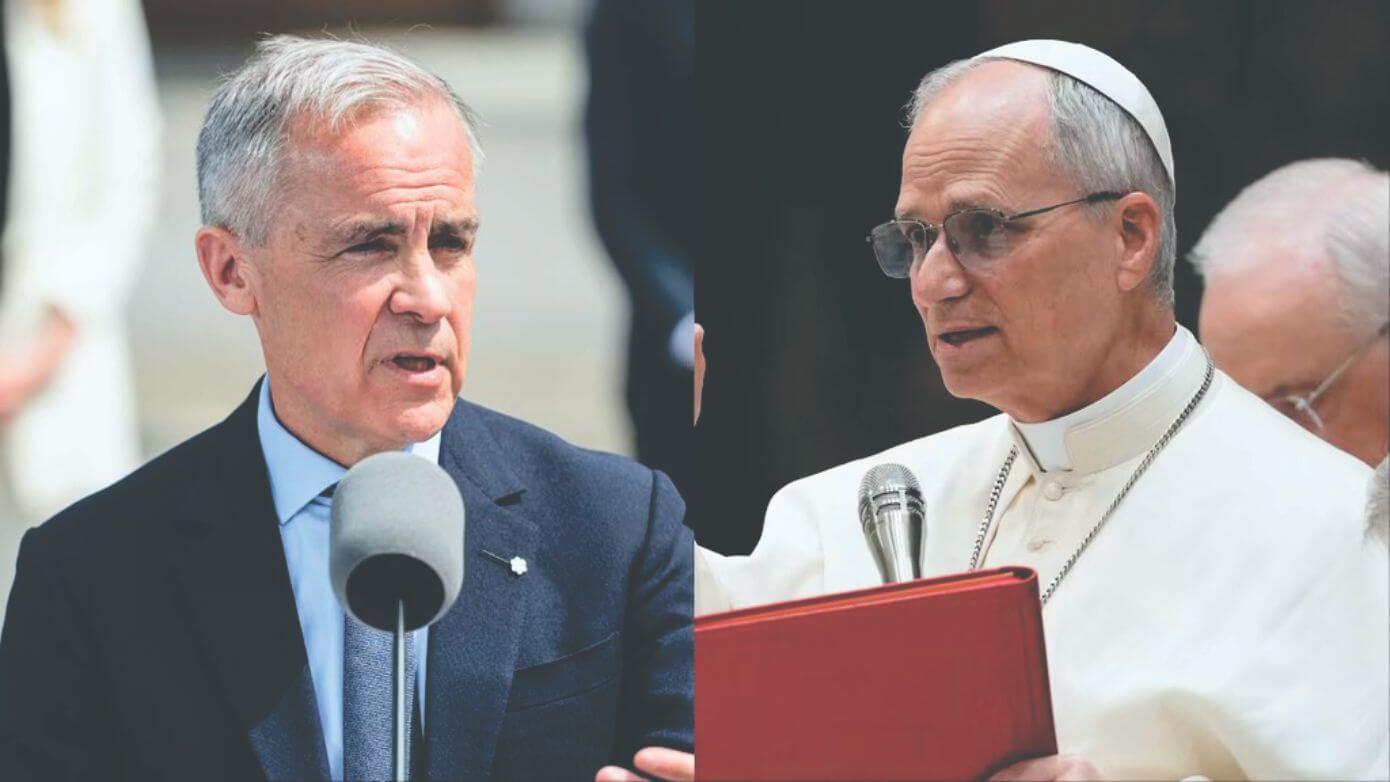
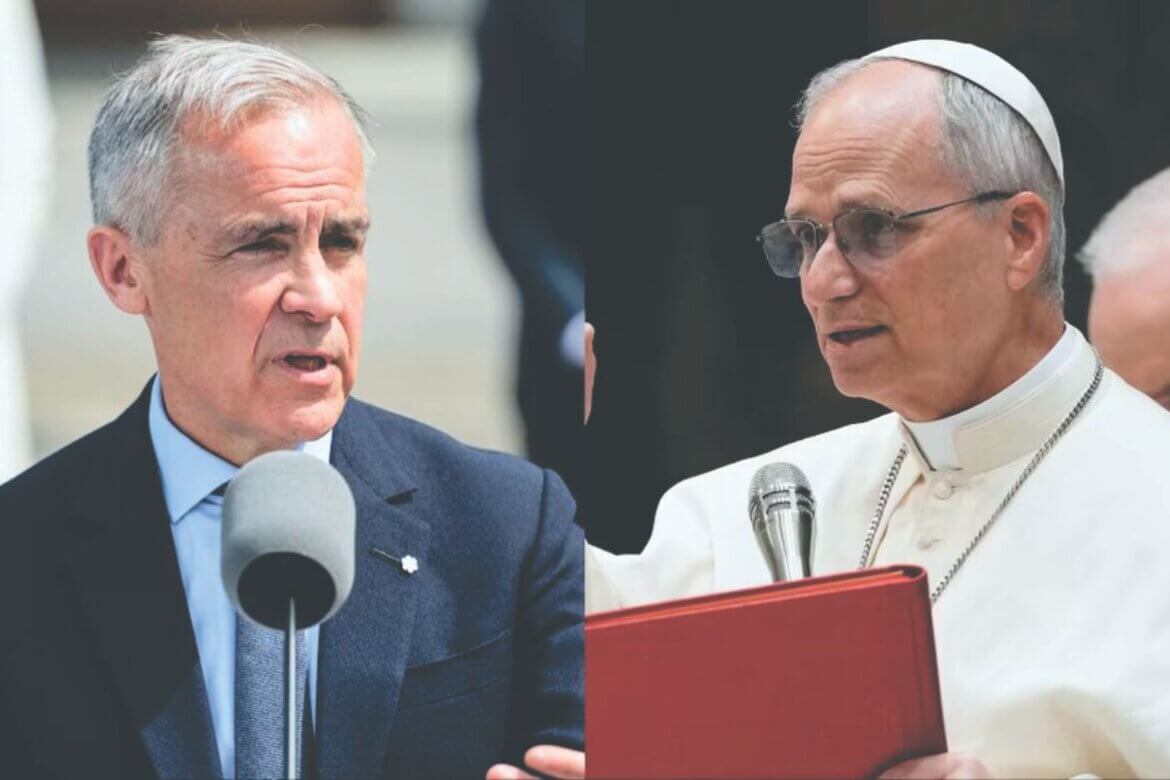
As a Canadian Catholic, I find it fascinating to watch the leadership unfold of Pope Leo XIV and Prime Minister Mark Carney, who each assumed office in the early part of 2025. Now, as the year draws to a close, it is possible to discern how each leader approaches the core problem in the world today: peace with social justice. One is our spiritual leader, the other our government leader. Our lives are affected by what they do. It is too early in their tenure to make any judgement on their leadership. Yet we need to know where we are headed in our church and in our country. The pope and the prime minister have barely begun, but their words and actions already tell us what their early priorities are or are not.
*****
Papal teaching has through the ages usually made for dry reading, but not Dilexi Te (“I Have Loved You”), Pope Leo’s first major document in the form of an Apostolic Exhortation addressed to all Christians. It is a heartfelt reflection on God’s enduring love for humanity and the Church’s mission to share that love with the world. (See Lead Story)
The document actually comes from two pontiffs — Leo finished what Francis had begun, but Leo’s signature of moderation and unity in love, which has been the core of the Church’s teaching for two thousand years is evident. He writes: “I am happy to make this document my own — adding some reflections — and to issue it at the beginning of my own pontificate, since I share the desire of my beloved predecessor that all Christians come to appreciate the close connection between Christ’s love and his summons to care for the poor.”
Dilexi Te is the Church of Jesus at its very best, tracing the history of how love of the poor has been the central message through the centuries leading up to the Second Vatican Council, which “represented a milestone in the Church’s understanding of the poor in God’s saving plan.” This foundation enabled Leo to state that the indignity suffered by the poor as a result of the “absolute autonomy” of the marketplace should constantly weigh upon our consciences.
The National Catholic Reporter hailed the document as a “breathtakingly bold salvo on wealth, elitism and poverty.” The style Leo used — calm, measured and loving — appealed to me greatly. In a church riven by the cleavage between what the media label as the “progressives” and the “traditionalists,” Pope Leo has shown a unifying grace. Divisions there undoubtedly are, but in love of the poor in the name of Christ we are unified. This sets his pontificate on a solid course.
The distinctiveness of Leo’s reign also showed in the choice of countries for his first travel. He journeyed to Türkiye (better known in the West as Turkey) to participate in the 1,700th anniversary of the Council of Nicaea, famous as the ancient site of the first ecumenical council, which affirmed the divinity of Jesus and produced the Nicene Creed explicitly defining the Trinity.
The pope was able to both strengthen ties with the Muslims and champion the goal of Christian unity, pointing to the great jubilee of 2033 when all Christians will celebrate the 2,000th anniversary of the passion, death and resurrection of the Lord.
Leo then went to Lebanon where he toured the suburbs of Beirut, heavily impacted by Israeli bombardments. He pleaded for peace in the Middle East and warned that humanity’s future was at risk from the world’s proliferating conflicts. Also, during his first year, Pope Leo met with Ukraine President Volodymyr Zelenskyy twice and issued a statement appealing for dialogue to end the Russia-Ukraine war, “opening the path to peace for the good of all.”
How Pope Leo, an American, will inter-act with the mercurial U.S. President Donald Trump has yet to be played out, but Leo’s opening moves are very interesting. On Oct. 8, the pope met with Bishop Mark Seitz, chairman of the U.S. Conference of Catholic Bishops. The bishop reported that the pope said, “The church cannot remain silent” about the situation of migrants in the U.S. where mass deportations of innocent people are taking place.
Days later, the American bishops’ conference spoke out against the Trump administration’s mass deportation effort and its treatment of immigrants in detention: “We pray for an end to the dehumanizing rhetoric and violence.” The pope then stated publicly that the pastoral message is “a very important statement. I would invite especially all Catholics, but people of goodwill, to listen carefully to what they said.”
Thus the pope was able to criticize U.S. immigration policy without directly naming or confronting Trump. In other words, he de-personalized what could have been a fiery direct exchange between Trump and himself. This seems to me to be a rather good example of diplomacy in action.
More subtle diplomacy was shown a few days later when the pope named Father Manuel de Jesús Rodríguez, an outspoken pro-immigrant pastor in the Queens borough of New York City, Bishop of Palm Beach, Florida, which just happens to contain the Mar-a-Lago estate of President Trump. Also, Pope Leo accepted the resignation of Cardinal Timothy Dolan of New York and appointed in his stead Bishop Ronald Hicks who, like the pope, has served as a missionary in Latin America. Leo is certainly sending messages to Trump and at the same time shaking up the American hierarchy.
Turning to interior Catholic issues, Pope Leo also seems to have defused the simmering tensions between the pro-Francis and anti-Francis elements in the Church by allowing the controversial Cardinal Raymond Burke to celebrate a pomp-filled Latin Mass in St. Peter’s Basilica. Pope Francis had severely restricted a Latin liturgy, earning enmity from the more conservative side of the Church.
There are different interpretations of why Leo suddenly allowed Latin back. Was this a reversal from Vatican II or a gesture that unity in the faith transcends the language used in the liturgy? I think Leo did it to foster unity between the waring sides. Just as his first document centred around the love of the poor, which all sides could agree on, so his liturgical action said: let’s get beyond style in how we worship the Lord.
A unifying moderation style may not, however, be enough to get beyond an issue that still flames at the centre of the Church: the ordination of women to the ministry. On Dec. 4, the Vatican commission studying the possibility of female deacons reported that the current state of historical and theological research “excludes the possibility of proceeding” toward admitting women to the diaconate.
The commission, composed of a combination of priests and women split on the issue of the “masculinity” of Christ. It seems strange, if not archaic, in the age of the universality of human rights, to be arguing that women cannot enter the ministry because they are not men as Christ was.
What does Pope Leo think of this thorny issue he has inherited? All he has said as the question continues to be studied is: “Perhaps we need to look at a new understanding or different understanding of leadership, power, authority, and service — above all service — in the church from the different perspectives that can be brought to the life of the church, by women and men, so there are conversations going on; there is an official study going on.”
*****
In November, Prime Minister Mark Carney wrote in The Economist that the international system has been “ruptured” by Russia’s invasion of Ukraine, gridlock at the U.N., growing American mercantilism and paralysis at the World Trade Organization — all of this contributing to the breakdown of the post-Cold War order of multilateral institutions. He sees the world now entering an era of “variable geometry” characterized by new pragmatic coalitions built around shared interests. The “coalition of the willing,” the ad hoc group of nations which has come together to support Ukraine, is a prime example of the new pragmatism at work.
“Variable geometry,” a phrase I had never heard before, does seem to be a perfect description of the mind of the economic technocrat who has entered the prime minister’s office at the strangest and perhaps most difficult time in the country’s history. Not since the War of 1812 has the very existence of Canada been so threatened as it is by the most irrational, vengeful and dangerous president the U.S. has ever produced. Carney must diversity Canada’s relationships — quickly.
David Crane, the business columnist of The Hill Times, reported, “No previous prime minister has spent so much time in meeting world leaders and travelling to foreign countries, nor done so much so quickly.” In short order, he travelled to Britain, France, Germany, Poland, the Netherlands, Brussels, the United Arab Emirates, Malaysia, Japan, Korea, Singapore, South Africa and Mexico, as well as meeting separately with the leaders of China, India, Sweden, Norway, Indonesia, Italy, Spain, the Netherlands, Norway, Denmark, Belgium, Iceland, Vietnam, the Philippines, and Jamaica. He has worked to restore relations with India and China, is planning a visit to India in 2026, and has accepted an invitation by the Chinese president to visit China.
Carney clearly wants to expand Canada’s economic base beyond the present over-reliance on the U.S. Yet, while he is doing this, he is paradoxically deepening our military ties with our southern neighbour. At Trump’s demand, NATO adopted a new policy wherein its members have pledged to devote 5 per cent of their GDP to defence spending by 2035. This will amount to another $150 billion for Canada, which the country cannot afford if it is to meet its housing, health and education goals. Carney justifies this by saying much of this amount will strengthen Canada’s industrial strategy programs. He sees himself as a builder — of new energy systems, vital infrastructure and streamlined inter-provincial trade at home, and new international alliances abroad. Defence spending, he says, helps this, a claim rejected by many other economists.
If he is trying to move away from integration with the U.S., why then has Carney entered high-level talks about joining Trump’s Golden Dome missile defence system? Two previous prime ministers, Brian Mulroney and Paul Martin, turned down Canadian participation in this fantasy. In his defence spending and Golden Dome moves, Carney has shown a disturbing reliance on military power as the route to peace. It is as though he is reluctant to use his star power to lead both Canada and his new international partners away from excessive reliance on military might.
The entire United Nations structure, built on the ashes of World War II, is grounded on the idea that human security comes not from more arms but the steady infusion of diplomacy into crisis areas and also more economic and social development. With his background in U.N. affairs, it is distressing to see Carney drastically cut Canada’s international assistance funding while simultaneously boosting military spending.
*****
Both Pope Leo and Mark Carney are affecting our lives here in Canada. Both face immense challenges: the pope in keeping the Church in a reasonable semblance of unity, the prime minister in fending off the avaricious Trump. Obviously, both want an end to the present wars and the development of social justice agendas. It seems to me they are on different routes to these goals. Leo has chosen love and moderation as his leit motif, Carney strength through arms as an economic lever. Pope Leo gives me some confidence in the future, Carney makes me feel very uneasy.
Douglas Roche, Edmonton, AB