

The Nazorean: How a Jewish Wisdom Sect Gave Birth to the Church – A Reflection
Paul LeMay, Vancouver, BC
Volume 40 Issue 10, 11, & 12 | Posted: January 21, 2026
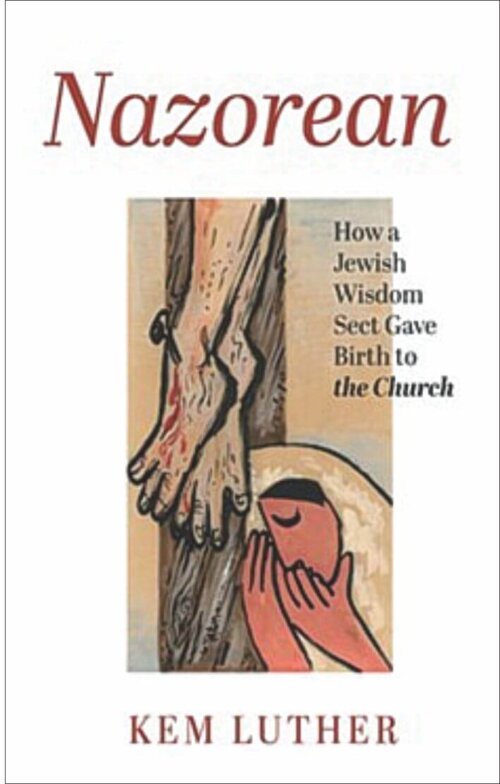
Setting the context: Some months ago, Pat Jamieson, the editor of this publication and a figure known to me for some 34 years, asked if I would be kind enough to review a book by Kem Luther. (And yes, it’s Kem, and not Ken, it’s no typo.) After he provided me with a bit of background while having lunch together in Vancouver, I said sure; and within the week, I received a copy of the book in the mail. Some months later, Pat told me he had taken part in a multi-week seminar series taught by the author himself in Victoria.
So you may be wondering why Pat asked me to write this piece, especially considering all the people he knows in his circles. Well, join the club. Since I am certainly no biblical scholar, I wondered that myself. But here is what he did know. He knew that in addition to my being raised a Catholic in Ottawa – and a Vatican II Catholic at that – he also knew I came with a few add-ons. These include several decades of serious inter-faith explorations along with a daily meditation practice since 1991. And I also came with an extensive academic background in psychology which came in handy when I co-authored two books with a psychiatrist on the topic of victimization and the nature of the human mind-brain system. In other words, Pat knew that I’d likely bring all of these experiences to bear in what I would read, and what might write. So, call this my opening disclaimer.
Originally, my assignment was to do a “book review” that would appear in the ICN’s autumn edition. This meant I was to read the book over the course of the summer. But then as September approached, and the issue’s contents swelled beyond Pat’s original expectations, it was apparent that whatever I intended to submit would simply fail to do the book justice if it was too brief in its length. So my piece got bumped to the winter edition. Of course, in the world of published writing, these things happen.
Then in late October, Pat asked if I might shift from doing a more traditional book review to a reflection piece. And so now, here we are. And truth be told, I actually prefer that over a traditional review. Why? Because the latter presumes I might share the same level of biblical scholarship and early church history knowledge that the author of this fine book possesses, which I certainly do not. But what I can offer are some overall impressions of what I read, and the occasional observation and insight that the book’s contents elicited in me.
Initial impressions: First, did I like what I read? For the most part, yes. Yet that said, by the time I got to page 240 of this rather modest 257 page book (273 page book if you include the Appendix), I have to say I repeatedly found myself a little bogged down in the mass of painstaking details, details which at times caused me to lose my sense of the evolving overall picture. It was as though I was toggling between a well-written detective mystery (which is what kept me in the game) and a detailed forensic written for biblical accountants, if there is even such a thing.
And sifting through the mind-boggling weight of case evidence demanded a certain amount of reader patience at times. Still, I can’t say I found the entire exercise without merit or intellectual reward. The reason I know that is from the number of times I found myself reaching for a yellow highlighter pen with some naïve belief that doing so would help remind me of some particularly exceptional insight, some gold nugget of understanding I was sure I would later want to reference for you the readers of this article. Then I realized that so many pages had earned the yellow highlighter ribbon of distinction that it would be next to impossible to summarize, let alone capture, each of those exceptional insights in any simplified way.
But one thing is clear. I can now see why the author referred to his process of discovery as the threading of individual pearls into a necklace. The only problem is that when you look at the finished necklace, it’s virtually impossible to appreciate the amount of wisdom that went into the making of each and every pearl, and therein lay the challenge in writing this reflection piece owing to the numbers of valuable pearls that make up this book. Nor is there any simple way for me to do justice to the entirety of this book or the author who with love and a genuine desire to know the truth, likely laboured over it for years. So what to do?
In this regard, I was reminded of what the Dalai Lama once said in Vancouver when he was asked what truth was. Initially, he shrugged his shoulders and humbly admitted he didn’t know, which immediately lowered everyone’s expectations. But then after a few awkward seconds, he suddenly he offered the following: The truth was like a multi-faceted diamond, where each facet revealed something unique that could not otherwise be seen from any other angle. This is the reason why we tend to become so attached and committed to our experience of seeing one particular truth. We are simply largely unaware of the other possible perspectives, and this is why people so often quarrel over who is right and who is wrong. But if we take the time to patiently consider the other person’s perspective and experience, and they do the same with us, both people learn and benefit.
So it was with the huge volume of historical facts presented within this book. Yet in order to get a better perspective of this whole diamond, I actually needed to step away from the book entirely for a couple of months to allow all the intellectual dust Luther’s exploration had kicked up in my mind to actually settle. And settle it did, hopefully into a more coherent and better integrated overall synthesis which I am going to try to present herein.
Time also allowed me to better discern the many competing psychological forces that not only laid brewing just beneath the social surface in the period immediately prior to the historical arrival of Jesus, but also here and now today. Obviously, this is a statement I’m going to unpack as we go along. But before I can do that, it would be somewhat unfair for me to engage in this aspect of my reflection without first providing a rough sketch of what this book is even about, and just who the author is.
Nazorean, the book: The Wide Shot
Not unlike his famous historical namesake who unleashed the Protestant Reformation, Kem Luther embarked on his own Herculean labour in this book. Within, he offers readers a methodical tour-de-force analysis that lays bare some of the various core strands of thinking that were present in pre-existing Jewish communities immediately prior to the foundational days of the early Christian church. This approach is very much akin to examining the multi-faceted diamond I made reference to above.
Luther builds on what he calls his five webs of imaginative construction. For the sake of brevity, I will only touch on three of these, the influence of the Books of Enoch, which had some impact on the Essenes in Qumran; the Books of Wisdom attributed to King Solomon; and the Nazorean sect itself. By framing the totality of material in this way, I believe the author was asking his readership to consider some new interpretive possibilities, based on some well-reasoned conjectures, to help all of us find a path through the pre-existing thicket of biblical scholarship surrounding the historical period immediately prior to the arrival of Jesus. I suspect he did this in hopes of understanding the potent formative philosophical influences that were acting on the minds and hearts of key local sect-communities of the time. As these more global ideas began to be either adopted or rejected within each of these existing groups found in different geographical areas, this also gave rise to a potential for either agreement or conflict between the individuals that made up these groups. And as one might expect, this eventually did give rise to a competition of ideas between groups. When these ideas began to threaten the ruling pecking order’s ability to exercise their power over those who no longer recognized their moral authority to lead the nation, this triggered a politically-based purgative reaction within the priestly class, one which ultimately resulted in the crucifixion of Jesus, described as a Nazorean from Galilee.
This in effect was the psycho-dynamic context out of which the early Christian Church would ultimately arise both religiously and politically. Indeed, it’s a process that continues to repeat itself to this very day in every institution known to woman and man, and it’s a process we today call victimization. This book is also the brief tale of the author trying to get a handle not only on this whole underlying process in his own life, as well as an understanding of the various chess pieces that were being played on the religious game board not only in ancient Palestine at the time, but in our own modern world as well.
Wrote Luther: “Buried somewhere in my journey – a trek through three different spiritualities and the rocky landscape of North American religion in the second half of the twentieth century – are the questions to which the webs of this book try to provide answers… The sects that emerged in late Second Temple Judaism built the houses that first-century Christians moved into.” [p. 23]
As I mentioned above, one of the strands of imaginal influence that Luther identifies is Enochic Judaism (pages 26-32). As you might have guessed, this body of wisdom knowledge is anchored around the Books of Enoch, of which there five. This antediluvian account attributed to the Jewish patriarch Enoch, the father of Methuselah, and great-grandfather of Noah, is widely believed to be a pseudepigrapha — that is, a work written under the name of an ancient figure to give those texts greater authority, where in reality, the work is likely the result of a number authors making various contributions over time. Although there is no clear evidence who each of these authors were, or when precisely these texts were written, when I looked into the matter more deeply, it is generally assumed that these works are no older than 300 BCE.
Indeed, there is good evidence the text was penned in both Hebrew and Aramaïc, and despite being a fantastical tale in its own right, it was reportedly popular for some 400 years in the surrounding region until the Council of Nicaea stepped in, and put an end to that. Where the story hits religious influence pay dirt comes from the fact that fragments in Aramaïc were found among the Dead Sea Scrolls in Qumran (p. 29). Such finds strongly suggests these texts were a revered part of the Essene community’s very selective body of wisdom literature. Wrote Luther: “Once fragments of Aramaic and Hebrew versions of the Book of Enoch turned up in the caves at Qumran [site of the Dead Sea Scrolls] and confirmed the age of certain parts of the text, [even] Biblical scholars began to take renewed interest in it.” (p. 27)
Now as for the import of the actual contents, Luther succinctly wrote: “The books relate [Enoch’s] journey to heaven and back.” and “his experiences, visions, and prophecies.”
Of course other scholars have now also had their say on this matter. For example, Mauro Biglino, who directed and supervised the translation and publication of 17 books of the Old Testament for one of Italy’s Vatican-approved Catholic publishing houses, treats Enoch as evidence of ancient encounters with non‑divine beings. Biglino’s broader ancient‑astronaut‑style interpretations are very much aligned with those of famed Swiss-Catholic author Erich von Däniken who is best known for writing Chariots of the Gods. When it comes to the Books of Enoch, Biglino favours a literal Hebrew translation over any minimizing theological interpretation, arguing that Enoch’s descriptions of “angels” and “watchers” more likely refers to physical beings, and not spiritual ones. He uses Enoch to support his thesis that biblical texts describe technological or extraterrestrial phenomena.
And Biglino is by no means alone in this view. Former Anglican deacon and biblical scholar Paul Wallis, who is also the author of a series of books challenging the mainstream interpretation of many Old Testament works, has suggested that the accounts made in the Books of Enoch should be reconsidered through a modern lens. When one does this, he contends the Enoch account is literally referring to Enoch’s journey aboard extra-terrestrial craft and his encounter with more technologically-advanced and spiritually evolved beings from another world. As it so happens, Wallis’s views are bolstered by similar first-person eye witness accounts that were scientifically studied and described by Harvard Medical School psychiatrist John E. Mack.
While Luther makes no similar claims in his book, he does make reference to how Enoch’s son Methuselah, when he was 65, and then, 300 years later, “walked with God, and was not, because God took him” so as to suggest he was in fact taken up into heaven. [p. 27] Luther then expands on the material on page 28. Here, according to Luther, some scholars believe the Enochian account predates the writing of Genesis, the so-called first book of the O.T. Bible. As such, there is no reference to the Garden of Eden or any willful human failure. “This is replaced by a story of an angelic rebellion in which the humans are passive victims. Nor do we hear about God revealing the law through Moses. Instead, God reveals divine plans through conversations with a patriarch who was the ancestor of all living humans, not just the Jews.”
While much of the foregoing may be somewhat shocking to modern ears, it may not have been quite as shocking to the ancients, although they likely framed the information in non-modern terms, preferring to talk about angels and fallen angels, rather than benevolent aliens versus more malevolent ones. (And isn’t it interesting that the term angels remains a much more psychologically palatable placeholder term within both the Christian and Islamic communities today than is the term extra-terrestrials.)
Where the Enochian influence became relevant in its influence on early Christianity was in its uptake in various “aspects of Essene theology, such as their belief in predestination, their confidence in the soul’s afterlife, and their interest in angels…” In other words, those guys were really out there.
Luther contends that whether we are talking about the strict monastic-style Essene community in Qumran, or the more moderate urban split-off version of the Essenes in ancient Palestine, this influence contributed “to apocalyptic themes and its focus on evil spirits”, which we still see today in various strands of Christianity, such as the Jehovah Witnesses and Adventists, as well as in the Epistle of Jude.”
And so why would that be? Here, I wish to comment. When the Romans first invaded ancient Palestine in 63 BCE to help quell a civil war unleashed by a battle over monarchical succession involving Herod, the amount of psychological trauma this would have unleashed in that society should not be underestimated. And here I wish to specifically address the various behavioural coping reactions people use in response to such trauma. Many people become more guarded, defensive and even paranoid, often displaying hair-trigger anger with openly aggressive threats. This is what typifies extreme expressions of the fighting mindset. It tends to view and treat any non-supportive actors as enemies of one degree or another. Others choose to flee the threatening context, and retreat into a non-engaging variant of learned helplessness. Hermetic sanctuary communities like Qumran are examples of such more extreme expressions. Such behaviours are characteristic of the defeated mindset. Still others respond by entering the appeasing mindset. When using this approach, they accept a measure of oppression by others in a Stockholm syndrome like way, in exchange for some assurances they will allowed to live. This kind of response also occurred in some European Jewish ghettos set up by the Nazis during the Second World War, particularly in Poland, where some Jews agreed to act as enforcers for their captors against their own people, in hopes this bargain with the devil would buy them greater leniency and favour.
Personally, I find it interesting that this trio of mindsets also finds echo in another unexpected area pertaining to the life of Jesus. Luther discusses this on pages 91-93, where he draws on the historical record of Josephus’s account of his own training as a lad in the late 30s CE. When he became sixteen, he decided to try out each of the three primary spiritual discipline sects available to him at the time, namely the Pharisees, the Sadducees and the Essenes.
Luther then conjectures that Jesus Himself may have followed a similar trajectory of study and formative internship as well. In evidence, Luther points to Matthew’s account of Jesus’s temptation trial by Satan upon his return from his 40 day fast alone in the desert. (Matt. 4-11 and Luke 2:41-51) In this account, Luther suggests that each of the three temptations are symbolic references to each of these three internship paths. Here in evidence, I present Luther’s case. In response to the first temptation that the Son of God has the capacity to turn stones into bread, Jesus replies: “It is written ‘you shall not live by bread alone, but by every word that comes from the mouth of God.” (Matt. 4:3-4)
Luther unpacks what goes unsaid between the lines of this encounter. According to Luther, this passage was an encoded symbolic reference to something else entirely, namely, Jesus repudiating the intermediary role that the Pharisee priests claimed to hold over others. The fact that Jesus valued heavenly manna – a direct and trusting relationship with God – more than earthly bread, he was openly challenging the expert status claimed by the priests who were the “trustworthy” guardians of the oral tradition, passed on from one generation to the next. In so doing, Jesus was claiming his own internal locus of control over his own powers of discernment (a.k.a. his soul’s sovereignty) over that of an external authority who set themselves up in an eminently corruptible position. In this regard, Jesus could be seen as an example of a Jewish Protestant. In other words, this was Jesus entering into the virtuous side of the fighting mindset.
And we’re not finished. In the second temptation of Jesus by the devil, where he was brought to the pinnacle of the temple, Satan says: “If you are the son of God, throw yourself off, for it is written that ‘he will give command about you to the angels’ and ‘they will catch you up in their hands, so that you don’t stub your foot against a stone.’” (Matt 4:6) “The devil is quoting Psalms 91:11-12 to Jesus.” (p.93) Jesus replies from Deuteronomy (6:16): “Do not put the Lord your God to the test.” According to the Luther, “this exchange may represent Jesus’s encounter with the teachings of the Essenes.” The Essenes were strict fatalists (a.k.a. finger-wagging karma junkies) with a tendency toward fatalism. “Jesus, as the Son of God, rejects such passivity. He is an active agent who has a give-and-take relationship with the Father. His obedience* encouraged by the Essenes. Challenging God to send angels to break his fall is not a testimony to this kind of relationship but to a lack of it.” (p. 93)
*[Here as an aside, I think it is worth mentioning that the original meaning of the word obedience (which comes from the Latin: obedire) referred to the capacity to listen, hear, or discern. If one reads the 14th century’s German Dominican mystic Meister Eckhart’s “Of True Obedience”, where he was intent on conveying this original meaning, the essay takes on a deeply insightful understanding about the interiority depths available within the spiritual experience.]
However, in terms of the three mindsets, the foregoing is an example of Jesus actually rejecting the limitations of living in a completely disempowered or surrendered egoless state, also another way of describing the defeated mindset. (To my inter-faith ears, this very much sounds like Jesus advocating for the Buddha’s teaching of the middle way – which in effect is about not indulging in extreme beliefs.)
With the third temptation, Jesus is effectively rejecting the hypocrisy of the Sadducees, who were willing to “prostrate themselves before the authority of the world and its riches. As Jesus will point out in this first sermon in Matthew, ‘you cannot serve both God and wealth’ (Matt 6:24).” In his response to Satan he says: “You will worship the Lord your God and give service to him alone.” But as Luther points out, “the word ‘alone’ is not found in the Deuteronomy passage. Jesus adds it to the quotation, I think, to heighten the contrast between his choice and that of the Sadducees.”
So, in passing through this triadic trial, and by not becoming the ideological psychological captive of any of these three then traditional pathways, Jesus opted for what might be described as a fourth way, and in so doing, was in a position to usher in a truly new spiritual vision, and one not only for his region at the time, but eventually, for the larger world as well. (The universality dimension of His message is something I will touch on again later.)
As for the sad old Sadducees, that’s another aspect of a larger psychological prison story, indeed one that still afflicts us today. Wrote Luther, “The Sadducees …were entwined with the power structures of Roman and Jewish politics. They tended to be wealthy, to live in the best houses, and to occupy the most important political positions.” (p. 93) Not only is this a feeling many can relate to today when we think of our stereotypes of politicians and billionaires; in mindset terms, it perfectly describes the very real moral limitations of the appeasing mindset, which is distinguished by its mixing of one’s internal locus of control with an external locus of control (i.e., one placed in others). Such is the basis of the Faustian bargain.
However, in the case of the more privileged Sadducees in ancient Palestine, today’s near equivalent would be referred to as the “upper appeasement” position in the spectrum of appeasement, which maps well onto the materially privileged upper middle class segment within our society. But it’s important for many of us to take some measure of moral ownership here. Why? Because based on the now famous research into obedience conducted by social psychologist Stanley Milgram, he found that about two thirds of people tested would comply with morally questionable instructions given to them by an apparently trustworthy authority figure. (These were instructions where one’s actions would directly harm another human being.) In other words, because most of us will simply go along to get along, even when our own material livelihoods aren’t even at risk, two thirds of us are in serious peril of committing the very same acts. And this is more so the case when one’s livelihood is actually in peril. Under these circumstances, our willingness to surrender to morally questionable authority figure edicts can climb as high as 90%.
So when taken all together, it should come as no surprise that in the wake of a psychologically traumatizing event, or series of such events, this is apt to induce one of these three (largely unconscious) kinds of survivalist reactions. Nor should it come as any surprise that as a consequence of such traumatic experiences, many people will begin to gravitate to new sub-groups for psycho-social support. But in many cases, this can be something of a mixed blessing since the new affiliation groups in question can potentially reflect the very same limitations of one’s previous already problematic mindset. The ideal is to be able to integrate a balanced use of each of the three mindsets, not to simply re-entrench the same old mindset patterns of thinking in a peer group that is similarly afflicted.
And as I alluded to above about Luther’s observation that the Essenes’ penchant to adopt what might be described as fear-based apocalyptic ideologies is very likely connected to people who tend to seek shelter from all the helter skelter by withdrawing from much of mainstream society altogether. And no less can be said for those whose psyches are keenly bent on looking for one or more messianic figures who will save the day. Within the defeated mindset context, any such a proposition, once implanted in the population, would find fertile psychological conditions to grow within.
The foregoing may also help to explain why the Books of Enoch were so apparently important to the Essenes. Their prevailing narrative about more powerful and wise beings who resided in the sky that were watching over humanity would have been just what the doctor ordered to give many hope that some outside intervening agent was going to ultimately save them. But Jesus redirects that narrative somewhat. For example, He never directly referred to Himself as the Son of God, instead he used a moniker actually used in Enoch, namely, the Son of Man. And when one looks at the thematic contents of his Sermon on the Mount, although he makes three separate references to the kingdom of heaven, the bulk of his sermon is not only about God knowing their pain in the face of their oppressors, but then Jesus pivots to an affirmation that from the spiritual perspective, they are already happy, in the sense they are cultivating great spiritual merit for enduring such hardship. “Happy those who mourn: they shall be comforted. Happy those who hunger and thirst for what is right: they shall be satisfied. Happy are the merciful; they shall have mercy shown to them. Happy the pure in heart: they shall see God.” (Matt. 5) Very bold, yet deeply caring declarations especially for those times.
As for those who victimize others to maintain their social status and hence their ability to wield power over others, as was the case with the Pharisees and Sadducees, their approach isn’t one of looking for a messiah. Rather, it expresses itself in a completely opposite way. Here the messaging tactic used is scapegoating. This in effect is why the “high” priests of Judea sought to have Jesus killed through crucifixion. It was their attempt to purge what they thought was an “infective agent” from their already (psychologically damaged) body politic.
So with all of the foregoing mindset material now in mind, it is also worth considering why every single Christian church chose to exclude the Books of Enoch from some measure of presence in their scriptures, the orthodox churches of Egypt, Eritrea, and Ethiopia being the exceptions. Indeed, in the Ethiopian Orthodox Christian Church’s Ge’ez, these texts effectively became canonical. But what is even more interesting to me is what Kem Luther offered on that topic. Shortly after “Western adventurers brought back copies of this work from Egypt in the eighteenth century [and by] the early nineteenth century, translations of the Book of Enoch from Ge’ez sources had been published in the various European languages.” (p.27)
Now that’s interesting! So why did that happen? Since most Europeans likely had little to no prior knowledge that these Enochian works even existed, the discovery of this material likely sent significant cultural shock waves through Europe. Why? For the simple reason that publishing of any book involves making rather hefty financial investments towards its production. Moreover, those that do generally only take such a risk if they feel they will be able to recoup those costs and even make a profit. Okay, fine. But that’s not all… When word of the books’ contents began to spread, one must also remember the context at that time. European culture was then cresting giddy with its intellectual enlightenment craze. So it’s easy to see why people’s curiosity might have suddenly been piqued, especially when the work in question had long been banned by the Council of Nicaea in 325 CE. Of course the contents, if true, held broader philosophical implications, implications many might consider another historical example of Church scandal. And there is nothing like a good scandal to sell newspapers and books. So, what exactly did the Church fathers of old at Nicaea not want the common folk to know?
Those somewhat familiar with the contents of Enoch will readily understand why those early and dare I say “Pharisee-like” bishops took the position they did. One of the work’s inherent “dangers” was that it opened the door to a lot of discomforting questions about the trustworthiness of humanity’s origins story as described in the two Genesis accounts. And any account that found itself at odds with the Genesis narrative was bound to raise a whole pile of discomforting questions. Then what other parts of the “holy scriptures” might be up for critical review and question? What could conceivably then follow is the potential erosion of trust in external authorities who preferred we only believe their list of “approved” things. The wider consequences had the potential to undermine the “faithful’s” entire appeasing-inclined mindset, yes the same mindset that gives rise to the Stockholm syndrome, as well as the battered wife syndrome, and that simply can’t be permitted to happen. For once the “faithful” begin to think for themselves, who knows where that will lead?
But the long arc of history has a way of catching up with those who made that judgement call. This in effect is what happened shortly after then Catholic Father Martin Luther nailed his 95 Theses to the doors of the Castle Church in Wittenberg at the end of October 1517. Many thinking European had simply had enough of the Catholic Church’s indulgences con game, and those ethically-challenged artists in Rome were finally being called to account for it.
Some will argue that the Enochian narratives are much ado about little (not entirely nothing), since the tales can just as easily be interpreted as just one ancient mystic’s questionable “visionary encounters” that took place on a spiritual metaphysical plane, rather than on any literal physical one. Still, even Christian readers should have the right to choose how they would prefer to interpret these texts. It should be entirely up to them. Yet the bishops gathered at the Council of Nicaea were certainly not about to take that chance.
But now I want to shift gears and tack to the heading that the author eventually took his exploration toward, namely the topic of wisdom and the Nazoreans.
Wisdom and the Nazoreans
One of the other potent formative strands of Judaism that became the precursor context in which Jesus Himself was raised revolves around the notion of wisdom teachings and how they could become embodied in personhood. And from pages 60 to 78, Luther spends considerable time exploring the various historical and scriptural nuances embedded in this topic. So, it is more than a little daunting for me to try to encapsulate all of that here without again doing the material a very serious injustice. But touch on it I must since it is the very lynch pin that allows the reader to contextualize its importance to the Nazoreans.
Those at all familiar with the wisdom books of Judaism will already know that much of this tradition derived material was attributed to King Solomon. So imagine my surprise when I learned that like the Books of Enoch, these works too were very likely penned by others and only attributed to Solomon to give them more weight and authority. Another pseudepigrapha? Of course, that doesn’t necessarily mean that Solomon was completely unaware of, or out-of-the-loop on much of this material. In fact, some of these works might have been his favorite references. So in this context, it is easy to see how the two things might have become conflated over time.
So in the interests of brevity, if such is even possible with this book, allow me to cut to the chase here. On page 67 Luther zeroes in on “The Wisdom of Solomon” the last Wisdom Book of the Old Testament, by an unknown author who was living in Alexandria, Egypt during the last century before the Common Era. Though the author was Jewish, it is “the only OT book authored in Greek.” (p.67)
The definite highlight for me in Luther’s discussion about wisdom in this regard, are the twenty-one qualities of Wisdom he listed from the Wisdom of Solomon, as translated by Michael A. Knibb.
For there is in [Wisdom] a spirit that is intelligent, holy, unique, of many parts, subtle, free-moving, lucid, unpolluted, distinct, invulnerable, loving the good, sharp, unhindered, beneficent, loving towards humanity, firm, unfailing, free from care, all-powerful, all-surveying, and penetrating all spirits that are intelligent, pure, most subtle (7:22-23).
Upon reading this comprehensive list, I was reminded of my own fortunate receipt of a number of wisdom teachings from the East. To my Buddhism-trained ears, this foregoing sounds like a list of qualities that might well have been the long-lasting teaching legacy of a Greek-speaking Buddhist teacher from India named Dharmaraksita. He was sent to the West as a missionary by the Indian-Buddhist Emperor Ashoka somewhere between 268 and 232 BCE. In this regard, it is reasonably likely that Dharmaraksita would have come to Alexandria during that period, especially given the fact that that city was the leading intellectual centre of the western world at the time. If that were indeed the case, then it is easy to see how anyone during the last century of the Common Era also living in that open-minded cosmopolitan community, could not only have come into contact with such Buddhist material, but perhaps (and it really is only a perhaps here) under the influence of such universal ideas. Then over time, this unknown Greek-speaking Jewish author person took pains to enumerate these very wisdom qualities as though they had found their origin in the mind and mouth of King Solomon. Talk about Chuztpah!
Insofar as the larger topic of wisdom goes, Luther also drilled down into the original Hebrew and Greek meaning of the word wisdom, one he says is more encompassing than the English notion which largely sees wisdom as the wise use of knowledge, where knowledge here, are simply matters of fact. Certainly the aforementioned quote from the Wisdom of Solomon would support this claim.
Luther believes this more expanded notion of wisdom is of pivotal importance in his larger hypothesis, and that the evangelist’s John’s view of Jesus as the embodiment of the logos, is essentially synonymous with a much earlier Old Testament view that wisdom is itself a person, albeit a disembodied one. To support this contention, he cites the first nine chapters of the Book of Proverbs, where he says Wisdom emerges as an independent personality (p. 63). In some regards, this very notion is still preserved in our concept of the Paraclete, or Holy Spirit, one of the faces of the Christian Trinitarian representation of God.
Owing to my own inter-faith explorations into Hindu yogic philosophy as well as Buddhism, I too have the benefit of a comparator. Each of these wisdom traditions has its own suite of terms that hover around this topic, namely Gyaan (knowledge) and vivek (discrimination), and the Sanskrit term for wisdom itself, prajna. Then there is the Tibetan Buddhist term, sherab or panya in the Pali language, and the east’s notion of skillful means, or upaya which one might call “applied wisdom”. Here I found a more complete overlap with the original Hebrew notion of hokhmah, a term Luther highlighted in his discussion of wisdom, and a term which implies skills by which we can “manipulate” the world. Of course this shares much in common with the Buddhist term upaya. So is this just another happy coincidence? Or enticing evidence of a cross-pollination between two distinct wisdom traditions of the ancient world? Or is it a mutual recognition of one universal bedrock design feature embedded in this intelligence imbued creation? Anyone’s guess really.
While I personally find all of these takes on the multi-faceted diamond concept of wisdom highly intriguing, and useful, like the unknown Jewish author living in Alexandria in the last century before the Common Era, I already preferred to view wisdom as a complex, multi-faceted qualitative proposition. And for me, it’s not all down to a series of deep philosophical insights. It is also experientially accompanied by a deep intuitive sense of knowingness, one which in some ways is akin to our so-called gut sense, yet with a heart-felt compassionate sense of inter-relatedness with the other. In short, a deep abiding sense that is well-reflected in the list of 21 qualities of wisdom, as cited above.
And while all of this may seem like some philosophically remote ethereal matter to some, it is by no means a trivial proposition. As one Tibetan Buddhist teacher from whom I once received in-person teachings over two decades ago put it: The two first co-emergent qualities of an enlightened mind are wisdom and compassion. Why co-emergent? Because they really can’t be separated. There is the compassion of wisdom, and the wisdom of compassion.
In my own personal spiritual journey, especially in meditation, I know this grace-filled quality of awareness will sometimes make its presence felt after my chattering mind has subsided and my sense of being becomes fully present in each life-giving breath and heart beat moment. This is what allows the last occluding veil of forgetfulness to drop. In that moment, I’m in pure simplicity. Another way for me to describe it is actually found on a T-shirt I own. It’s emblazoned with words from North America’s first people and it succinctly reads: “Listen to the wind, it talks. Listen to the silence, it speaks. Listen to your heart, it knows.”
The foregoing reminds me of a number of Jesus’s related insight-packed sayings. Two of these that came to mind are from the non-canonical Gospel of Thomas:
“The Kingdom of the father is spread out upon the earth, and men do not see it.” (Gospel of Thomas, 113) As well as: Whoever has ears, let him hear. There is light within a man of light, and he lights up the whole world. If he does not shine, he is darkness. (Gospel of Thomas – 24)
The second of these sayings is the definite echo of: “If therefore thine eye be single, thy whole body shall be full of light” (Matthew 6:22 KJV) – a metaphor suggesting the need to learn how to focus one’s attention so that one’s field of awareness might enter into communion with the divine through a meditative state. Yet sadly, this saying has been questionably re-interpreted in many “modern” biblical translations to read as: “If your eyes are healthy, your whole body will be full of light.” Seems to miss the point entirely.
No less is the case when Jesus says the kingdom of God is within you (Luke 17:21 KJV). Yet the very essence of this pointed saying has been diluted to “among you”, or “in your midst.” Of course, something vitally important seems lost.
Yet in Matthew 6:6, Jesus seems pretty emphatic: “…when you pray, go to your private room and, when you have shut your door pray to your Father who is in that secret place, and your Father who sees all that is done in secret will reward you.”
A phrase that is entirely consistent with Psalm 46:10, which would likely have been well-known to Jesus: “Be still and know that I am God.”
From these foregoing examples alone, it isn’t hard to imagine that Jesus was quite familiar with these same types of deeply settled experiences. And these states did not simply arise during his 40 day period in the desert after his baptism, but at many other times too. It is known that he retreated into solitude and away from the maddening crowd, and even his own disciples, many times.*
(I find it curious that while both the Catholic and Eastern Orthodox Churches made definite space for meditation or centering prayer within their now ancient monastic contemplative traditions, other than the Anglican Church and the Quakers, none of the Protestant churches I know have included this highly valuable spiritual practice in their traditions. Why? Very curious)
And when I reflect on many more of Jesus’s sayings and teachings, I can readily feel this same sensibility vibe containing both wisdom and compassion as one seamless whole, being equally conveyed. More importantly, I find his sayings strike a universal chord that definitely transcends the limits of any single wisdom tradition. And this, I believe, is what His message ultimately was all about.
Yet taking into account all the tremendous political turmoil that took place in some regions of ancient Palestine both immediately prior to the birth of Jesus as well as after it, and the traumatic effects this would have had on a large segment of the population, how was it possible for Jesus to even get to such a place within himself? Some of the answer is embedded in Kem Luther’s exploration of the Nazoreans themselves, the topic we move to next.
The Nazoreans were a sect of devout practicing Jews, which Luther suggests were initially based in Judea, in and around Jerusalem. This sect likely split into two factions to escape the violence that arose during the Judean civil war around the year 63 BCE, when the Romans invaded to support one of the two rival monarchical contenders. Over time, each of these factional sub-groups tended to reflect slightly different philosophical views, although I am also inclined to add all the specific psychological mindsets of individuals into the mix. Those with young families in particular would have good reasons to move to more politically tranquil regions of Palestine, such as the lands around the Sea of Galilee.
The importance of this formative foundation in Jesus’s early life becomes even clearer later in the book (i.e., page 238), when the author re-summarizes the distinction between the two definitely related yet slightly different Nazorean sects of Judaism: The much more communal family-centric “s-Nazoreans” of the countryside, and the more Hellenistically porous “i-Nazoreans” of Jerusalem and other urban anchored communities, such as Alexandria, Egypt. And as Luther additionally put it: “The i-Nazoreans stressed individuality, and the s-Nazoreans emphasized family and kinship.” (p. 232)
In Alexandria, the “i-Nazoreans” earned the historically verified name of “Therapeutae” (cultic servants), owing to their involvement in the healing of both physical and spiritual ailments (this according to Philo on p. 152). Members of this group also practiced meditation and sought to understand the facts of Nature. (p. 153)
Thus when the civil war troubles began in Judea between 63 and 30 BCE…“Members of the sect who were more influenced by Hellenism and philosophical/mystical perspectives responded to the rise of Herod in a different way. Some of them left Jerusalem, perhaps in the exodus of the 30s BCE, and migrated to the Jewish diasporas in Samaria, Egypt and Asia. Others remained in Jerusalem and its satellite villages. Some of those communities, when they were located in Greek contexts, became known as “Therapeutae.” They continued to emphasize lives of personal holiness, and they formed voluntary ascetic communities around their special forms of worship. Both men and women became part of these fictive kin groups. These are the ones I have called i-Nazoreans.” (p. 241)
Now presuming that Jesus spent much of his early life growing up in Nazareth, a community that Luther suggests got its very name from the Nazorean sect of refugees that re-settled there, many decades earlier, this has significant psychological importance owing to what modern emotional attachment theory (as espoused by Donald Winnicott, John Bowlby, Mary Ainsworth, Mary Main, Sue Johnson, Cindy Hazen and Phillip Shaver) has to say on the topic of early life experience. By taking their century-long scientific observations and insights into consideration, chances are they would all agree that in order for Jesus to have been able to bring so many of His spiritual gifts to the fore at such a young age, two things would have had to happened beforehand. First, he would have had to been raised in a loving and relatively financially secure family. Why so? As John Bowlby put it: “Human infants are biologically wired to seek proximity to caregivers for survival, and this early bond shapes emotional regulation for life.” [Bowlby, J. Volume 1: Attachment (1969)] And second, if one was to summarize much of the attachment literature in just one sentence, it would be this: Our human nervous systems have been designed to be regulated in healthy, caring and secure relationships with one another. In other words, we are literally meant to love and care for and about one another. Sounds a lot like what Jesus was all about and professing in his teachings.
This is well reflected in the case made by Kem Luther about (what he calls) the s-Nazoreans, who lived in the region of Galilee, and who were very much anchored in preserving and nurturing healthy family kinship networks. So within this emotionally healthy early life context, Jesus was likely given the great developmental benefit of having been in a number of emotionally healthy, caring and secure relationships. And as John Bowlby suggested above, such a foundation would have well served him when it came to being able to empathically relate to, and care about the suffering of others. Those familiar with the so many recurrent themes of His teachings, also know the central importance He placed on demonstrating love in both word and deed in the nurturance of healthy relationships. And much of this come through in the miracles he performed healing so many sick individuals, and as we saw in the words He spoke in the Beatitudes.
One of the most telling and relevant quotes from Luther I found in this regard, comes on page 241 when he revisits and summarizes contentions he made earlier in the book.
“In previous chapters, I imagined how Jesus and his family may have been connected to [the Therapeutae sect largely found in Egypt]. Joseph, I suggested, came from the Galilean s-Nazoreans, Mary from the Judean i-Nazoreans. Their son Jesus appears to have united in his person – and reflected in his teaching—the two factions of the Nazorean sect. During the years of his public ministry, Jesus drew followers from both camps. After his death, sect members from both factions accepted Jesus as the expected Nazorean Messiah.”
And as Luther points out in the remaining material on that page, it wasn’t long after Jesus’s death, that the two Nazorean factions sunk back into their entrenched differences. This in turn gave rise to the expulsions of Hellenic Jews from the Hebraïc Jews in Jerusalem, and it effectively became the launch pad for what became the exponential growth of the Christian Church itself.
What strikes me most about this is the fact that the very people who often had had actual personal contact with Jesus while he was alive, had still somehow failed to internalize enough of His message. For some largely inexplicable reason, after Jesus died, the message that this essential embodied common denominator was trying to convey, and which had previously bound this Nazorean community together, just slipped between their fingers, which then gave rise to much of the subsequent factional infighting. So why is that?
On page 238, Luther suggests it all boiled down to a philosophical conflict between what he calls the Hellenists and the Hebraists, as highlighted in Acts 6-8. In Acts 6 … “the followers of Jesus, faced with one of the periodic and violent pogroms of the Roman client leadership in Judea, decided to prune away the parts of the movement that were forcing them to the Jewish periphery. To give the lopped-off elements the best chance to survive, the community set up a shadow apostolate to guide the group … The apostles “prayed and laid hands” (6:6) on seven men, commissioning them to lead (and lead away) the ones that were being expelled from Jerusalem. The expulsion may have been the occasion for a formal excommunication by the Jewish leaders the aposynagōgos … Once the objectionable Hellenistic cells of the Nazoreans were expelled, the Twelve presented themselves to the Jerusalem leadership as Sabbath-keeping, law-observing Jews. What the Twelve and the s-Nazoreans did not foresee was that the dispersed i-Nazoreans, vested with their own leadership, would lay the foundation for a gentile church.”
Yet the foregoing was nothing compared to what transpired between established Jewish synagogue authorities and St. Stephen, one of the early Greek-speaking Christian deacons.
“After an incendiary speech that challenged temple-based worship” [a Samaritan theological view of the time], Stephen “is dragged out of the city and stoned to death. On that day, Luke reports, “a huge persecution arose against the Jerusalem church, and all were scattered through the regions of Judea and Samaria, except the apostles. (8:1)” (p. 234)
Although some of the early Christianized Jews (e.g. many of the original Apostles) chose to hold fast to most of their Jewish laws and traditions, the underlying psychological reasons for the break between the Hellenists and the Hebraists had, in my opinion, less to do with who possessed the highest form of spiritual truth, and more to do with each individual’s attachment to their personal mindset style. As people tend to default to seeing and interpreting their world through the lens of being either a fighter, an appeaser/negotiator, or a hermit-inclined individual temperamentally operating in the defeated mindset (or a rarer healthier integrating mix of all three), we are dealing with a much more psychologically complex proposition than what first meets the eye, even in terms of the in-group/out-group dynamics of tribal inclusion or exclusion, and all of the highly primitive (lower mind) pecking order processes that go with it.
Yet in either psychological framework case, we continue to see these very same group expulsion dynamics transpire within our own society today, dynamics we more commonly refer to as group conformity pressure, of which peer pressure is a notable example. We saw a biting recent example of this during the Covid-19 pandemic panic. It didn’t take long for those who were disinclined to question any of the scientific narrative being widely promoted by governments and public health authorities (our new Pharisees and Sadducees equivalent?) to clash with those who were more inclined to question what they were being told. And unless you were living under a rock, this sometimes ignited emotionally-traumatizing differences of opinion between fellow family members, friends and even work colleagues, giving rise to divisions in worldview that still remain owing to a number of factors, the most prominent of which are psychological traumatization and a general unwillingness to question external authority.
And here’s the point: Whether in ancient Palestine or in modern day, when an emotionally traumatized person endeavours to interpret reality, higher reasoning capacities are effectively short-circuited by the threat detection systems of our brains. Getting out of that threat state requires considerable mindful effort to re-establish emotionally balanced self-regulation. More often than not, this again requires mindful effort over longer periods involving much incremental reflection, as well as a willingness to question many of our own previously sacred assumptions about things. But in the moment when people feel they are living in a period of crisis, such as the Roman army going house to house and conducting what is effectively an ethnic cleansing exercise at the behest of the ruling Jewish religious order, or one’s own government pressuring you to take an experimental mRNA Covid-19 shot to help maintain the health and well-being of your community, the psychological pressures involved are in the very least kindred ones.
When so many people were psychologically traumatized in the case of Covid-19, and neither side can even agree on the merits of the scientific evidence found on each side of the debate, the possibility for emotional rapprochement, let alone genuine healing, is apt to remain slow. Similarly, when people of a given long-established faith tradition are suddenly being confronted with the proposition that the long prophesized messiah had not only arrived, but that they were instrumental in killing him, all while the Romans continue to occupy your land while extracting tribute from your purse, it isn’t difficult to see how one sub-group of Jewish people in ancient Palestine might interpret the teachings of Jesus versus another, and how each of their respective interpretations might also end up clashing.
Therein lay some of the broader implications arising from the pearls of wisdom contained within this book.
Conclusions:
So what were some of the goals achieved in this grand exercise? In my view, one such achieved goal was to get a reasonably reliable historical understanding of the philosophical environment into which the life of Jesus was inserted. A second achieved goal I think was an understanding of the formative philosophical influences that would likely have had impact on Jesus’s thinking as he grew to be a man. And the third goal this work likely achieved was to see which of the various strands of religious and spiritual thinking were preserved from what eventually emerged out of the nascent Jewish-Christian community womb as a result.
While for many, the contents of this book might often feel like “an inside baseball” examination of questions most church-going folk would likely have little time, let alone much interest exploring, there is something spiritually profound, if not therapeutic, in committing one’s self to co-journey with Kem Luther in his pilgrimage through the twisted tangle of traditions that has become today’s rather disjointed, if not jumbled cedar hedge of Christian churches.
At the risk of making a claim that the author himself might not feel entirely comfortable with, I found that the various historical weaves of traditions he outlines within Nazorean could well be argued to mirror the various “psychological profiles” of those who identify with one of the different strands of many of today’s Christian denominations. This is something that Luther himself suggests by leaving a trail of bread crumbs to follow in this regard. One example of this was when Kem Luther made reference to sociology of religion academic Bryan R. Wilson’s typology of religious sects:
“Those who try to classify the early Jewish church with Wilson’s sect types, we discover to no surprise, place it in several different – and sometimes multiple – types. But if we focus on that moment when Christianity was still Judaism, there is one of Wilson’s sect types that fits it rather well. This is one that he calls the “conversionist” type. Represented in the modern church by groups such as the Pentecostals and the Salvation Army, conversionist sects center their teaching and activity around evangelism … They set up a specific personal experience as a test of admission to the group, emphasizing individual sin and redemption. To encourage this experience, conversionist sects adopt a variety of revivalist techniques. The mainline group that they define themselves against is viewed with distrust, especially its professional clergy … [However] When we force the primitive church into a single category, we overlook the Adventist themes that we see in Paul’s letters and the Gospel of Matthew. We also overlook an important stream of Jewish thought that is not well modeled in Wilson’s sect typology – the wisdom tradition in Judaism and the early church … We need a better handle on the earliest expressions of Christian Judaism before we can begin to compare it – or parts of it – to other sects.” (p. 48-49)
What slowly began to become evident to me, not only just after reading the above quote, but after slowly considering the author’s outline of his own early life experience, including his formal higher education as a Protestant, I could see how this might have fed his subsequent interest in trying to understand the reason for so many denominational expressions of today’s Christian churches. And when this same generic probing question was applied to what was unfolding within Judaism in ancient Palestine, two to three centuries before the arrival of Jesus, it begins to become clear that the various composite strands that made up Judaism at that time, bear an eerie psychological profile resemblance to what we see today. And when one applies that tool to the emergent overall process, one he was trying to identify largely through historical and scriptural analysis, the ability to better see the underlying process driving historical events became much more evident to me. In other words, Kem Luther was simply missing another valuable tool of insight in his already exceptional tool kit. But without him carrying much of the heavy research load embedded in the work he did, I very much doubt that I could have put any such icing on his already exceptional cake.
Paul H. LeMay, BA (Psych) is a semi-retired independent science writer living in Vancouver. You can watch a 9-minute summary video on: “What’s Your Mindset?” on the home page of the website for the two books he co-authored with Hifzija Bajramovic, MD, an Ottawa-based psychiatrist here: www.primalmindprimalgames.com
Paul LeMay, Vancouver, BC