
‘Pope Trump’ and the ‘New Catholic Moment’
Massimo Faggioli
Volume 40 Issue 7, 8, & 9 | Posted: October 22, 2025
The Trump age coincides with a new “Catholic moment” in the United States. And it’s certainly different from the previous ones, such as the early 1960s with the presidency of John F. Kennedy or the late eighties when Richard John Neuhaus, one of the major thinkers of the neo-conservative movement in the United States, published his book The Catholic Moment: The Paradox of the Church in the Postmodern World in 1987.
On May 1, referring to the growing number of roles now held by the Catholic Secretary of State Marco Rubio, Vice President JD Vance, a fellow Catholic, posted on X: “If only there was a job opening for a devout Catholic … “
That same day, Cardinal Timothy Dolan and Bishop Robert Barron – two prominent members of the U.S. Catholic hierarchy – were appointed to President Donald Trump’s newly created commission on religious liberty. Among the commission’s 14 members are prominent Trump allies, but there is also Carrie Prejean Boller, former Miss California 2009 and Miss USA runner-up in the same year. (All members of the commission are Christians, except for Rabbi Meir Soloveichik.)
“Trump II has made possible the return of right-wing Catholicism in the halls of American power, in ways that have never been true for liberal Catholicism in U.S. history.”
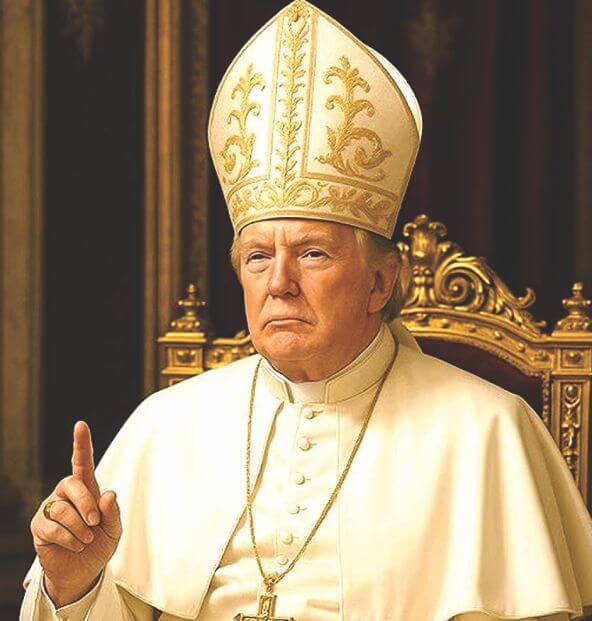
On the other hand, this new Catholic moment comes at a price. On April 30, President Donald Trump indirectly endorsed Cardinal Timothy Michael Dolan of New York at the conclave for the election of the new pope. This hardly meant a bella Figura for Cardinal Dolan in the eyes of fellow cardinals and bishops. Most shockingly, on May 2, Trump posted an AI created photo of himself dressed as the pope, a social media post published on his own personal account and then republished by the official accounts of the White House. Cardinal Dolan and the New York State Catholic Conference openly criticized President Trump for this mockery of the church. More predictable was the silence of law-and order Catholic politicians who support Trump in Europe.
These new “Catholic moments” entail new challenges for the Church in the United States, but also for the Vatican and globally. One challenge is how to deal with the clownishness of populist strongmen. There are many fascinating ways in which comedy relates to politics and theology, but this is not comedy. It’s the normalization of contempt for everything and anything, based on the assumption that raw power lets you get away with anything, even with persistent and proud displays of inhumanity. The Catholic Church must learn – faster than other religious traditions whose Leaders are not also heads of state or part of the world’s oldest diplomatic corps – how to respond to post-manner, ad-like, AI generated, para-religious imagery serving charismatic political leadership.
An important lesson presents itself here for those who believe that the future of Christianity is in a post-ecclesial dimension. Whether you were outraged or not by Trump’s AI-generated photo of himself as pope, the fact is that people still care about the Church, its symbols, and its tradition. A false or exaggerated opposition between the “prophetic” and the “institutional element” in the Church is one of the bases of religious Trumpism. The post-institutional means for religion also allow for the possibility of buying or appropriating, selling or divulging (in any way), using or consuming everything, including religious events. A naive post-ecclesial religious futurism is defenseless against populism, which is a mix of materialistic politics and appeal to profound, unexpressed religious and spiritual needs.
One last observation: there is a cautionary tale in Trump grabbing Catholicism by the papal mitre during the mourning period for the death of Francis and the preparation of the conclave. In Italian, there is a saying: La troppa confidenza fa perdere La riverenza. A literal translation would be “too much confidence makes you lose reverence” (which means respect here, but reverence rhymes with confidence). A better translation would be “too much intimacy makes you lose decency”. Trump would not have tried, and even less succeeded, in that stunt with other religions or other churches. He did it for two reasons: because Catholicism represents surreptitiously a “civilizational” pillar in U.S. culture and politics today, and because he knew he could get away with it. The assumption is that Catholicism is his to treat as he wishes, because he bought it and it’s Catholics that should be grateful to him (which is what you surmise when you hear some Catholics talking or writing about how good this presidency is for the church).
Massimo Faggioli