
Chanting The Feminine Down: A Psychological, Religious and Historical Novel by James C. McCullagh
Virginia LaFond, Ottawa
Volume 40 Issue 7, 8, & 9 | Posted: October 22, 2025
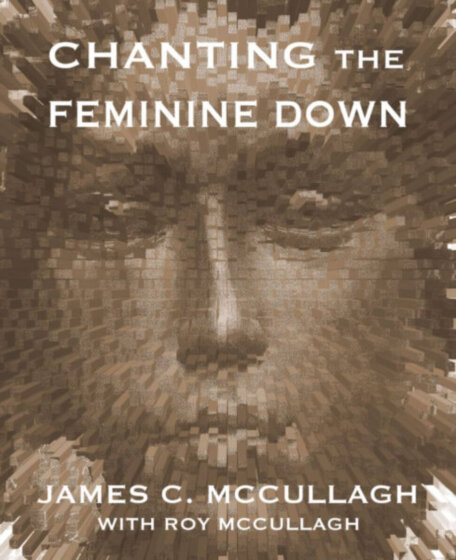
This is a book review that was requested of me by my friend Jim Noonan. As you may know, Jim Noonan sends pieces all over the globe and invites comments from those on his list. He asked me to write this piece because “You have a background in mental health.” That I do have but really I know just a few basics of the Jungian theory referred to in Chanting. Nevertheless, as my report will indicate, I appreciated my read of it and learned a good lot. As a social worker (retired), one particular point that I found extremely well done by McCullagh is that he had the protagonist walk around the subject (the Council of Trent), studying what came into her vision in that outside-the-subject space.
I’ve tried to have three others, viz., feminist friends, appreciate this tome. To my disappointment, not one did. One, a published author many times over, socked it because of its Amazon publication stamp. My response: “Forgive/undersand the author. Can you suggest a publisher?… Just try getting a book published as a first-time author these days”.
When one is presented with Chanting the Feminine Down: A Psychological, Religious, and Historical Novel, one is given a tome requiring that Google be close at hand – unless one has a well stored mind of facts about church councils (particularly Trent), popes, Martin Luther’s theses, poetry (including Rilke), art (early and late Renaissance), dream psychology (Jungian, that is) and Christian feminism (but not John Paul Ii’s feminine genius type.) In short, as some would say, no poolside book is this.
James C. McCullagh has written a book which began “as a dream, a poem, and a prayer” as he explains in the after word (to be read first if you desire some assistance navigating through Chanting). He has structured it imaginatively in order to make several crucial points about, for example, how the council of Trent avoided the matters of Martin Luther’s theses and the place of women in Catholicism.
His protagonist, Collette, is a graduate student on a full scholarship with an academic load of religions, literature and psychology. Her thesis is about “the influence of the Council of Trent on the feminine in the Catholic Church.” She attends tutorials animated in lively manner by Professor Gleason who often enough comes dressed in costume for these occasions. His objections to Collette’s way of studying the Council of Trent – by reading extant literature written before and around the time of Trent ‘in order to gain perspective’ – rather than on Trent itself, are made clear.
Her thesis advisor, Professor Merkel, is found to be helpful to her as he ‘slipped in and out of doctrine, as if changing his skin…His romp through the Italian Renaissance seemed like a high-wire act…” Early in the book, the reader is introduced to Collette’s counsellor who has studied Jung extensively and who attempts to assist her to make sense of her dreams – dreams that are often described in full awful detail. As well, the conversations between Collette and her mother insert good fabric into Chanting. For example, one of her mother’s points to emphasize that Collette is perhaps spending too much time on Trent is to remind her that their parish priest ‘got through Trent in a week’ in his seminary studies.
I learned or was reminded of a lot through my note-taking read of this book, i.e., the Church’s initial response to the printing press was to ban books; the biases and angles of the writers who wrote up the council; the presiding pope at the end of the Council of Trent, Pope Pius IV, declared that those who disagreed with the resolutions of Trent were “heretics and preachers of anathema” (and, as McCullagh has it, this, the pope did without reading a word of the writings himself); the long arguments about the difference between veneration of saints and adoration of God; how Jung was first to call “image” “psyche”; the martyrdoms including that of Anne Askew (burned to death in the Tower of London in 1546 after being nearly pulled apart on a rack – all this by Church authority; Boccaccio’s book, Famous Women (luckily, the reader will find reference to the humanist Boccaccio and this book on Wikipedia).
One outstanding boon for me, who relies on the knowledge of others for Church history, was the finding about Trent regarding the position of women in the Catholic Church. On that, McCullagh has given it one deservedly clear and total put-down. He has Collette say it succinctly: “I am pushing myself into a man’s world like a bull in a china shop. I search for the feminine and male doctrine holds me back”.
Aside from my struggle to determine at different points in this novel if Collette is living reality or dreaming, I found this book certainly worth the read, one that drew me to the not unpleasant task of making multiple discoveries.
Virginia LaFond, Ottawa