
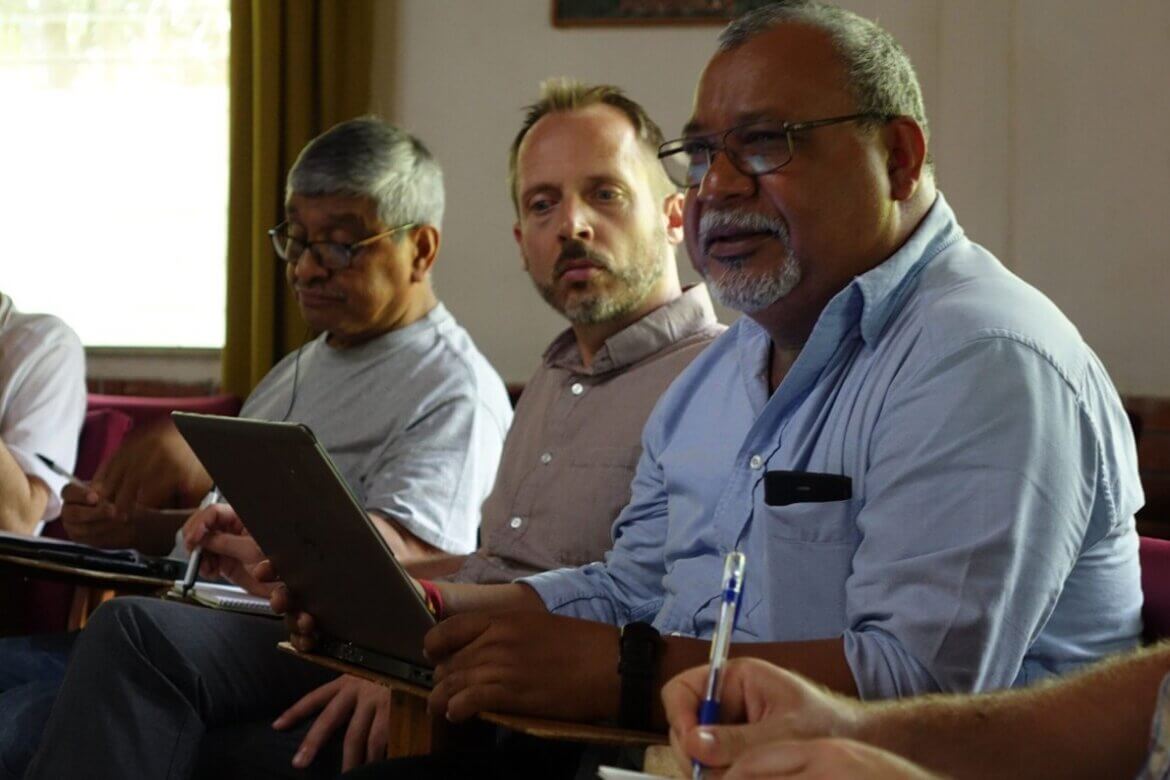
Padre Melo: Turning Personal Loss into Collective Hope
José Sanchez
Volume 40 Issue 7, 8, & 9 | Posted: October 22, 2025
Introduction
Island Catholic News, through Peter Gubbels and Phil Little (of Ladysmith) has been supporting and acompanying Padre Melo sj and his important work in Honduras for a good number of years now.
This article from the Canadian Jesuit magazine is our latest report on the progress and significance and effectiveness of his work. The devotedness of his prayer routine is striking, especially in light of the dangerous atmosphere of his work.
We often wonder why, despite success or security, we still feel that something is missing. Beyond the rush of achievement or the comfort of security, there’s a yearning for meaning that stays with us. Maybe the answer lies not in having more, but in living for more. Perhaps that’s why the story of Fr. Ismael Moreno, SJ, known affectionately as Padre Melo, speaks to so many. Born to a Honduran farmworker, Padre Melo shows us what becomes possible when we listen to that deeper call.
“The deepest joys are never to be found on the market, in supply and demand,” reflects Padre Melo. “I find them in that which is neither bought nor sold: in gratitude. Friendship, commitment, the struggle for a fairer society, these are things that cannot be bought — they have no price.”
Inspired by Martyrs, Moved to Serve
Growing up in a poor farming family, Melo’s journey began when his father, a grassroots peasant-farmer leader, was murdered in 1974. Rather than letting tragedy breed bitterness, this loss sparked in him a deeper quest — to understand how faith could transform pain into purpose, how service could heal both the server and the served.
His path was shaped by witnessing those who chose to serve despite danger. He recalls a pivotal moment: seeing Fr. Guadalupe Carmen, dressed all in white, walking alongside peasant farmers fighting for their rights. “Knowing a priest who worked with peasants, alongside my father’s murder, left a mark on me,” Melo notes.
The final catalyst came in 1977, when Jesuit priest Rutilio Grande was assassinated in El Salvador. Death squads gave the Jesuits 60 days to leave or face death. Their response moved young Melo deeply: They chose to stay. “I called up a Jesuit and told him, ‘Since Fr. Rutilio Grande has been killed, I will replace him,’” he remembers.
Finding Strength in Community
Today, in his sixties, Melo continues his lifelong commitment to reconciliation and justice as the founder of ERIC (Reflection, Research and Communications Team) and Radio Progreso in Honduras. ERIC-Radio Progreso are long-time partners of Canadian Jesuits International, the international solidarity agency of the Jesuits of Canada that supports poor and marginalized people in the Global South. Through these Jesuit organizations, teams of dedicated journalists and researchers investigate human rights violations, advocate for marginalized communities and provide vital analysis of social issues.
This in a context where people are being displaced from their land due to mining activities, where people live in extreme poverty and where speaking for their basic rights often results in death. Yet despite death threats for this work of amplifying silenced voices, the team at ERIC and Radio Progreso persevere in their mission.
This discovery reflects a truth woven throughout the Christian tradition: that deep strength is found not in self-reliance but in trusting God and walking alongside others. Practices like the Examen — a daily prayer that helps individuals recognize God’s presence in their lives — foster resilience by revealing meaning even in hardship. Time and again, those who embrace this way of life discover a deeper joy that sustains them, not only in their own challenges but in their service to others.
What sustains him? First, a profound faith in God who is “not distant, who does not punish; a God who does not condemn or persecute, but rather a God so great that one feels he is commensurate to the scale of our fundamental human and spiritual needs.”
Second, the memory of those who gave their lives for others: “I have seen and known dozens of men and women who were killed for their commitment. That memory is so essential to living my vows, to nourishing my hope and to keeping me from faltering or turning back.”
But perhaps most concretely, he finds strength in the very communities he serves. “I live in probably one of the most impoverished countries on the continent. But every weekend when I visit these communities, I am given so much. They own their poverty to such an extent that they share it. And when they share it, their poverty is then transformed into a shared lunch, a shared embrace, a shared smile and a shared faith.”
A Message for Those Seeking Purpose
To anyone wondering whether a more meaningful life is possible, to those searching for meaning in an increasingly secular world, Melo offers clear guidance: “Look, you have the chance to discover profound joy by breaking out of the mould of the lifestyle that has been imposed on us. You will not discover this by yourself, but rather, by walking in community with others.
This wisdom echoes the teachings found in Scripture and in the lives of saints and spiritual leaders throughout history: “For where two or three gather in my name, there am I with them” (Matthew 18:20). Modern research supports what faith has long taught — that those who practice gratitude, live with purpose and engage in meaningful relationships, report greater well-being and resilience. This connection between personal faith and collective action is what empowers individuals to step beyond their own needs and become instruments of God’s love in the world.
Melo challenges the notion that fulfilment comes through consumption: “You will never find joy in consumerism, because this joy is always fleeting and will leave you emptier than before. Discover genuine joy by building a shared life, by living more simply. You do not need to accumulate things, chase the latest smartphone, live off appearances; rather, live more simply, with few things, and share these with others.
This wisdom resonates particularly in our current moment, when many feel disconnected despite being more digitally connected than ever. Melo’s experience suggests that the path forward lies in moving beyond superficial engagement to authentic relationship, beyond passive observation to active participation in creating a more just world.
A Daily Practice of Purpose
Each morning at 4:30 a.m., before his day begins, Melo sits in silence, “begging our Lord for light in order to be more generous, insofar as possible and in view of the limitations.” This practice grounds his work in something deeper than mere activism — a spiritual foundation that sustains hope in Christ, even in the face of opposition.
What makes his witness particularly powerful is how it integrates contemplation with action, personal transformation with social change. “Our apostolic mission in the service of peace must always be by peaceful means,” he emphasizes, drawing from his experience of Central American conflicts. “Profound change must be advanced through peaceful means.”
Working alongside him is a team of 59 laypeople who “will never make their fortunes working here at the radio. They put themselves at risk and are threatened with death. However, you will always encounter celebration, joy, generosity and dedication. This team is a gift from God, and through them, I too discover where I belong and my strength to keep believing.”
José Sanchez