
Other news
Crime Scene Photo: Thomas Merton Death Image Explodes Myths
Patrick Jamieson, Victoria
Volume 40 Issue 7, 8, & 9 | Posted: October 22, 2025
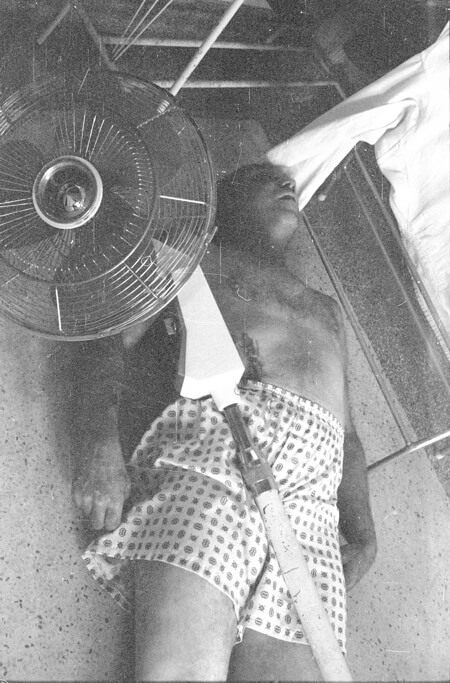
The photo accompanying this story requires an explanation; in fact it is the whole story. Thomas Merton’s death has always been murky, if not mysterious. Like Princess Diana, people like that do not die that way, at least not without a load of questions.
As for the photo itself, it was kept hidden for five decades. It was taken moments after Merton’s dead body was discovered by three entirely reliable witnesses. The first on the scene included those monks attending the monastic conference in Bangkok, Thailand in December 1968 where Merton was featured as the keynote speaker.
He had just finished lunch after the morning session and was going back to his cottage on the Red Cross campus for a rest before speaking again in the later afternoon. He was accompanied by one cottage mate and was followed five minutes later by Father Celestine Say, OSB from the Philippines who took the photo. According to David Martin and Hugh Turley in their 2018 book, The Martyrdom of Thomas Merton, An Investigation, Merton met his death in the five minutes before Say reached the four-person cottage.
Merton was accompanied back to the cottage by Rev. Francois De Grunne, OSB, from Belgium, the last person to speak with him when still alive. Say had the ground floor unit next to Merton, De Grunne was above Merton. Say’s testimony contradicted the story that Merton had a shower and electrocuted himself on a faulty electric fan. Say shared the shower facility with Merton and would have heard him taking a shower, which he decidedly did not.
The photo itself contradicts the generally accepted story of the shower accident, as Merton still wore his undershorts. It also records that his body was in an unnatural position, for someone who fell; the body was in an arranged position. It was suggested to Say that he get his camera to record the scene by Rev. Egbert Donovan, who was the very first witness to arrive at the scene and he did not like the look of the situation, as though suspiciously arranged.
FRANCOIS DE GRUNNE
The suspicious character who accompanied Thomas Merton back to his fatal moment was the Belgium Benedictine Francois De Grunne, who according to his monastery disappeared shortly after all this. His behaviour throughout the day bears all the hallmarks of an accomplice in the crime. Someone was waiting for Merton and he was shot in the back of the head as he slipped off his outer garment in an effort to cool down for a rest. There was only one key to the cottage and it was passed around casually. De Grunne’s job was to draw attention to Merton’s situation after a suitable time had passed.
This required a certain amount of waiting on De Grunne’s part, a time when he was observed acting oddly. Pacing, asking Say if he heard a noise, and even stranger behaviour when he went to let others know Merton had taken a fall. The Thai’s police treated the situation almost casually, with confusing details, and most tellingly, no autopsy. Always a telltale sign of irregularities.
Turley and Martin detail all this in their two books, The Martyrdom of Thomas Merton, An Investigation and Thomas Merton’s Betrayers, the case against Abbot James Fox and author John Howard Griffin.
But the photo if studied closely tells its own story. Merton looks fit and robust which contradicts another hypotheses, that he suffered a sudden health breakdown. How the photo was managed to be kept from the public limelight is a whole saga in itself, and largely the subject of their second book (2023). The salient aspects of which include the fact that previously respected author John Howard Griffin (best selling author of Black Like Me) was a CIA agent and Abbot James Fox (Gethsemane monastery in Kentucky) would only allow Merton to travel to the far east for the conference if he signed over to the monastery the massive royalties for his books if he should die. Merton’s earning were funding five Trappist monasteries in 1968.
I have closely studied both these volumes as someone who naively swallowed the cover story which they work to expose. Unfortunately it has been case closed for many, and admittedly it must be very difficult to accept as the authors dismantle the myths around how and why Merton died.
My own awakening came about through my successor as editor of Island Catholic News, Marnie Butler. A convert to Catholicism in the late 1980s, Marnie read her way into the religion, largely through Merton and Catholic Worker founder Dorothy Day. Marnie was also a compatriot of the Institute for the Study of Non Violence and its protege folk singer Joan Baez in Palo Alto, California.
Baez was a friend of Merton as peace activists, having spent time with him at his hermitage at Gethsemane Monastery in Kentucky. While there, she introduced him to the music of Bob Dylan, who he recognized as the contemporary Villon, the French Symbolist poet.
In those circles, Merton’s death was understood immediately as an assassination in line with Bobby Kennedy and Martin Luther King the same year. Marnie had no hesitancy about this revelation to me to whom it made intuitive sense, and to the Canadian Catholic Press Conference in Vancouver in the mid 1990s to whom it was transparently confounding.
The International Thomas Merton Society has the same problem to this day, dismissing Hurley and Martin’s investigative efforts in favour of the conventional wisdom which they carefully and comprehensively seem to dismantle if given an honest chance and read.
At the Catholic Press Conference, one could hear a pin drop when Marnie made her self-confident assertion, followed by the muttering of ‘We haven’t heard that before’.
Excerpts from Turley and Martin’s Release
On December 10, 1968, at around 4 pm at a cottage at the Red Cross retreat center near Bangkok, Thailand, where they were attending a Catholic monastic conference, three Benedictine monks found Thomas Merton’s body when they entered his room. Abbot Odo Haas, Archabbot Egbert Donovan, and Father Celetine Say immediately recognized that Merton was dead. The scene was so odd that they did not touch anything before they photographed the scene to preserve the evidence.
This photographic documentation of Merton’s body at the scene created a permanent record that preserved details of the body position, appearance, identity, and final movements. The monks intended to give the photographs to the Thai police to show them how they had found the body, but when the police arrived, it became clear to the monks that the police were not doing a proper investigation.
Fr Say took two photographs of Merton’s body from different angles. He later said that he did not tell the police about the photos because he thought that they might confiscate his film and camera. After the film was developed he sent one of the photographs (the other was underexposed) and a letter on March 18, 1969, to Merton’s Gethsemani Abbey in Kentucky. Burning with curiosity over the odd death scene, Say asked Abbot Flavian Burns if there had been an autopsy to determine the cause of Merton’s death before his burial. The abbot, in fact, had not ordered an autopsy and none had been done, although the doctor’s certificate and the death certificate affirmed that a “post-mortem examination” had been done in accordance with the law.
Abbot Flavian shared Say’s photograph with John Howard Griffin, who had been named as Merton’s biographer. Griffin immediately recognized the significance of Say’s photographs and joined Abbot Flavian and Brother Patrick Hart in an effort to secure the film negatives from Say. They praised Say for taking the important pictures and asked him to send them the negatives to that they could be protected.” Say sent his negatives to the abbot as a gift. The negatives became the property of the Abbey of Gethsemani.
In 2017, we discovered Say’s negatives in the papers of John Howard Griffin at the Butler Library of Columbia University and quickly saw why they were hidden. With modern technology we were able to get the underexposed negative developed, and the two photographs reveal what looks for all the world like a crime scene that had been staged to appear to be an accident.
The first thing that the witnesses saw was the unnatural position of the body. They saw Merton lying flat on his back with his arms straight by his side. When someone falls on a floor, it is almost impossible that a person will fall straight back with their arms at his side. Normally knees bend and arms are extended out to break the fall. A falling person goes down akimbo and not straight.
It appears that the last movements of Merton’s body were made by someone else, who placed his arms at his side to roll him onto his back. A fan was then placed on Merton’s body. The witnesses were confused by the stand fan lying across Merton’s body, resting on his right pelvis. The base of the fan was near his feet and the blades to the side of Merton’s right shoulder.
Vernon Gebert, author of Practical Homicide Investigation, writes that “if you have a gut feeling that something is wrong, then guess what? Something is wrong” The initial gut feeling of the first witnesses was their subconscious reaction to the presentation, which alerted them that things were not what they appeared to be. This was why Say took the photographs.
A perpetrator purposely alters the crime scene to mislead the authorities and/or redirect the investigation. Placing the fan on Merton’s body would have been a conscious criminal action on the part of the murderer to thwart an investigation. No wonder witnesses were bewildered.
Some of the muddled descriptions of Merton’s death came from his former abbot, James Fox. Fox said that Merton had been electrocuted by a faulty wire in a large fan in is room. According to Fox, Merton either had a heart attack and grabbed the fan and it fell with him; or he had been fixing the fan and grabbed a badly insulated wire.”
The staged scene left the public to debate whether the cause of death was an accident or a natural cause. The placement of the fan by the perpetrator directed attention away from a head wound seen by witnesses. Authorized biographer Michael Mott in The Seven Mountains of Thomas Merton revealed that the wound, which was in the back of Merton’s head, had “bled considerably.” In his very next sentence Mott writes, “The obvious solution appears to be that it was caused when his head struck the floor.”
Say’s photographs were hidden for additional reasons. The photographs prove that Merton’s abbey knowingly spread false information. The abbey said the fan was found lying across Merton’s chest which had been burned deeply. A wound on the chest would suggest that it had something to do with the heart failure. Say’s pictures prove that there was no such burn on the chest. The abbey reported that there were cuts on Merton’s body and that he had taken a shower before his “accidental electrocution.” No cuts are visible in Say’s photographs and Merton was wearing his pajama shorts. He was not found near a shower and Merton would not wear pajamas in a shower.
If Merton’s death had been caused by “accidental electrocution,” then Say’s photographs would provide evidence. Say’s photographs did not support the false narrative, and they contradicted stories told by the abbey, which is the most likely reason why they were kept secret. The officials at the abbey also decided to keep hidden the official death certificate, the U.S. Embassy Report, and the Doctor’s Certificate of Death. None of those documents state that the cause of death was “accidental electrocution,” which would further explain the need for secrecy.
Standard police procedure is to treat every unattended death as a homicide until homicide can be ruled out. Nothing that the Thai police did was in keeping with that procedure. The apparently staged crime scene, the concealment of the official reports, the hiding of the photographs, and the invention of false stories are further indications that Merton was murdered.
The Abbey of Gethsemani refuses to grant permission for even drawings of the Merton crime scene photographs to be published. These images could be published by the news media without / permission because the press comes under the “fair use doctrine” and the public right to know. The abbey and news media-including the Catholic news media-that created and have continued to perpetuate the unfounded story that Merton was “accidentally electrocuted” also continue to suppress the photographs that indicate murder.
Patrick Jamieson, Victoria