
How Mark Carney’s Catholic Faith Will Inform the Way He Governs Canada
Stephanie Levitz
Volume 40 Issue 4, 5 & 6 | Posted: July 26, 2025
INTRODUCTION
By Patrick Jamieson
This article from The Globe and Mail purports to report on the new prime ministers’ Catholicism. Unfortunately it suffers from the usual static concepts. The use of the term ‘devout Catholic’ isn’t very useful and not only because it sounds dated, ie pre Vatican II.
Carney is also mislabelled as a liberal, he is really more of a progressive conservative and that is the reason he won the election, he out conservatived the populist conservatives. This more than losing his own seat, and losing a 25 per cent lead in the polls, is what Pierre Poilievre has more to fear and regret.
The popular wisdom is that Carney wiped out the social democratic New Democrats, but the effect more was to erase liberalism from the ballot, at least the kind Justin Trudeau represented. Justin channelled the CCF roots of his father Pierre Elliott Trudeau in the way he governed.
I doubt if an NDP government would have gone as far as Justin in his ten years of power. Now Carney is a Progressive Conservative just as he is a more accurately progressive Catholic as Doug Roche argued in his article in the last edition of ICN, entitled. ‘Carney Sees Politics as a Medium to Lift Up The Common Good.’
He attends the progressive Catholic parish St. Joseph’s in Ottawa, served on Pope Francis’ Inclusive Capitalism commission and his book on values demonstrates his intentions as a reform minded business class market capitalist.
The worry for socialist Catholics is whether he can take the next step from progressive to prophetic Catholicism, which includes a radical concern for the poor, disabled, women and global issues. It was impressive on his part that when Donald Trump in his moodiness seemed to be lessening the threat of massive tariffs at one point in the process, Carney did not retreat into self-congratulations as a Canadian but rather shifted the focus to the bigger problem that the Trump presidency poses for the global order.
Along with the new pope, Carney seems able to counter certain aspects of Trump’s troublesome personality. Hopefully he will demonstrate the capacity to emulate Pope Leo’s constant concern for social justice and the plight of the working person, as reflected in his choice of name and the tradition of progressive Catholicism that was started in 1891 with Rerum Novarum, the first great social teaching encyclical which is the bedrock of prophetic Catholicism.
Prime Minister Mark Carney’s trip to the Vatican Sunday for the mass marking the inauguration of Pope Leo XIV is both a diplomatic overture and an event of personal significance.
Mr. Carney is Roman Catholic, and as he noted in a statement upon the election of Pope Leo, a new papacy is a major milestone for the faithful.
“This is a historic moment for the Catholic community and for all those who look to the Vatican for guidance,” he said.
His trip in turn raises questions about whether or how, as he governs Canada, he may seek that guidance.
At the start of the recent election campaign, he told reporters that he doesn’t talk publicly about his faith or spirituality.
“What’s relevant is that it informs my sense of responsibility and service,” he said. “I feel that I should serve our country the best I can.”
But there are numerous signs of how faith plays a role in his life.
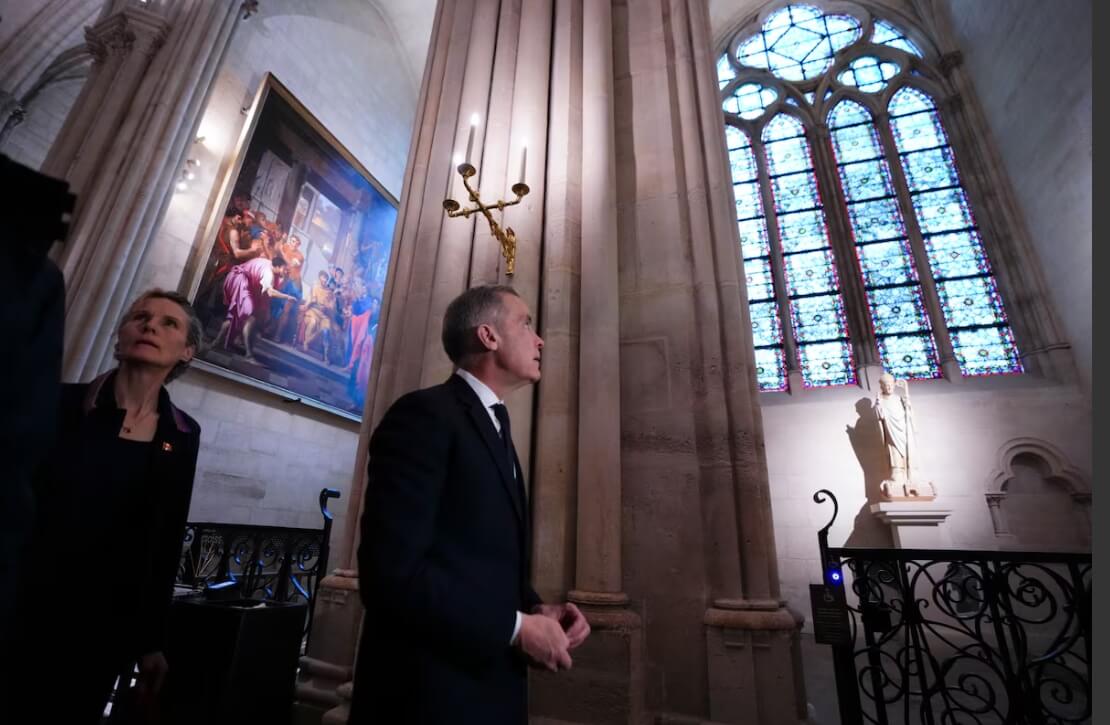
On the morning of his first foreign trip as Prime Minister, before he met with any diplomats or dignitaries in Paris, Mr. Carney visited Notre-Dame cathedral, which had been severely damaged by fire in 2019 and recently reopened.
He and his wife, Diana, paused in front of small bins of white votive candles. Catholics light candles as a visible sign of prayer, and Mr. Carney bought one for himself and one for his wife. As he touched a match to the wick, he told a passerby – in French – that he was saying a little prayer for Quebec and for Canada.
Mr. Carney is a regular churchgoer. He went to mass the morning the election campaign began and twice on Easter Weekend, in the final days of the campaign. While Governor of the Bank of England, he was a parishioner of St. Mary’s Church in Hampstead and was the guest of honour for its 200th anniversary celebrations.
He is also a self-professed admirer of Benedictine monk Laurence Freeman, the head of the World Community for Christian Meditation, whose seminars he has addressed.
The influence of the church on Mr. Carney goes beyond the pew.
In a statement marking the death of Pope Francis, he relayed a story about when the two met in 2014.
“Pope Francis issued a challenge that has guided me ever since. He likened humanity to wine – rich, diverse, full of spirit – and the market to grappa – distilled, intense, and at times disconnected,” Mr. Carney said.
“He called on us to ‘turn grappa back into wine,’ to reintegrate human values into our economic lives.”
Well after that encounter, Mr. Carney published his book Value(s): Building a Better World for All and included the anecdote in its opening pages.
To observers, the tome is a clear riff on Christian teachings that the economy exists not to be a self-serving beast but to uplift.
“Mark Carney maintains that the values of economic dynamism and efficiency should be joined with those of solidarity, fairness, responsibility and compassion,” wrote Catholic Register columnist Glen Argan earlier this year.
“All popes since the First World War (and perhaps some before that) have said much the same.”
In fact, Pope Leo XIV’s namesake, Pope Leo XIII (1878-1903), laid some of the foundations of modern Catholic thought on the economy, as the Second Industrial Revolution gave rise to concerns that workers’ rights and dignity were being destroyed.
In choosing the name Leo, Cardinal Robert Prevost tied back to that work. But he also cast forward to concerns that artificial intelligence creates new challenges for human dignity and labour, which he intends to address with his papacy.
Mr. Carney is bullish on AI but has also reflected on its risks. His party’s platform promised more investment in the technology – but also a close eye on its impacts to “ensure no one is left behind.”
In the cabinet he announced this past week, he named a first-ever Minister of Artificial Intelligence and Digital Innovation, though the portfolio’s mandate is currently undefined.
Unlike politicians in the United States, where having no religious affiliation can render a political career a non-starter, Canadian politicians who are practising Catholics have long faced scrutiny over the balance between their faith and their work.
It is a particular sore spot in Quebec, where politicians have come under criticism for publicly endorsing their own Catholic faith, while mandating secularism for the government itself.
Before Justin Trudeau even became Liberal leader, his Catholic faith was questioned by rival politicians, who said he wasn’t Catholic enough to be an appropriate guest speaker at a Catholic school.
Mr. Trudeau, at the time, cited his faith in his personal opposition to abortion, though he supported a woman’s right to access one. Several years later, he would say that his position had “evolved” and that he no longer personally opposed abortions.
Mr. Carney has said that he “absolutely” supports a right to choose.
When William McGrattan, the president of the Canadian Conference of Catholic Bishops, was asked by a Catholic news outlet to respond to Mr. Carney’s position, he replied: “I would say that someone who is in politics and claims to be living according to their faith and making such statements, we see the disconnect, and this is unfortunate with many of our politicians.”
Brian Dijkema, the president, Canada at Cardus, has many questions about how Mr. Carney’s faith will make itself manifest in government.
The non-partisan think tank, whose work is informed by Christian theology, has played host to Mr. Carney numerous times.
As an example, Mr. Dijkema pointed to the expansion of Canada’s medical assistance in dying regime. Allowing broad access to MAID conflicts with Mr. Carney’s focus on ensuring that the economy supports the most vulnerable, he said.
“If we’re not taking care of those people, you know, I think there are legitimate questions to be asked about how Christian that view of economics is.”
Showcasing a Christian view of economics while running central banks is not the same as having the power that comes from running a government, Mr. Dijkema said.
“Power is intended to execute justice, and justice biblically, and through our tradition is often the question of justice for those who can’t speak for themselves or who are too weak to do so,” he said.
“We’ll have to see what this government will actually do.”
Stephanie Levitz