
Main Feature
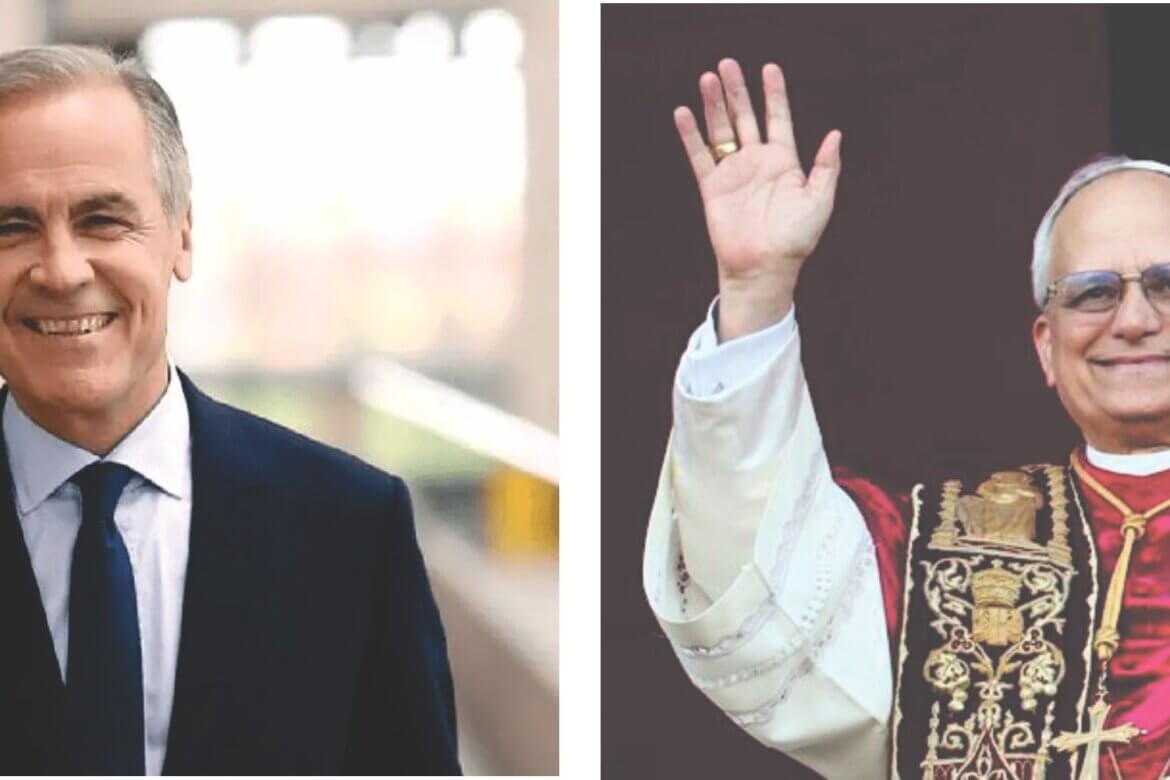
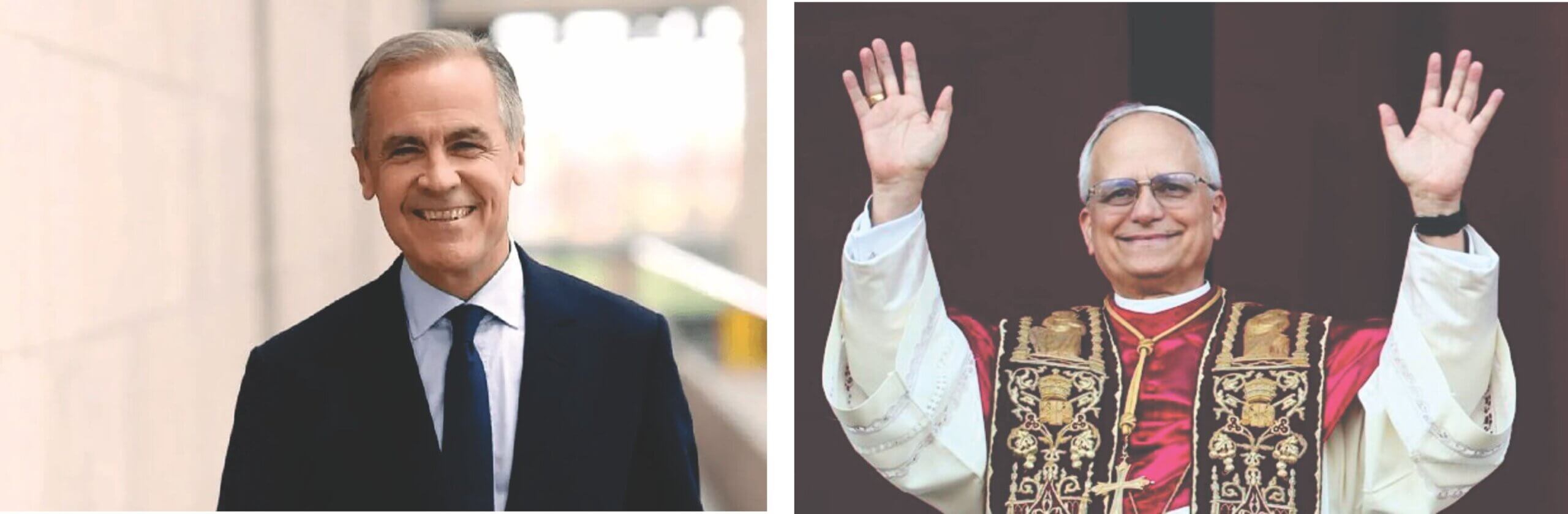
Carney and Leo XIV Challenged by Prophetic Call
Douglas Roche, Edmonton, AB
Volume 40 Issue 4, 5 & 6 | Posted: July 26, 2025
On May 15, 1891, Pope Leo XIII, who as Gioacchino Pecci had served as the popular Archbishop of the papal state of Perugia for thirty years before ascending to the papacy, issued an encyclical, Rerum Novarum, on the rights and duties of capital and labour. Thus was laid the foundation of Catholic social teaching, which was developed by a series of subsequent popes and embodied in the documents of the Second Vatican Council. This is the teaching that Robert Prevost, an American-born priest who spent two decades as a missionary in Peru before his election as pope, made his own by the selection of his papal name, Leo XIV.
On June 26, 1945, the Charter of the United Nations was adopted in San Francisco to maintain international peace and security, uphold international law, achieve economic and social development, and protect human rights and fundamental freedoms for all without distinction as to race, gender, language or religion. In addition to prohibiting the use of force against a state, the Charter calls for the maintenance of international peace and security with the “least diversion for armaments of the world’s human and economic resources.”
There is a link between Rerum Novarum and the U.N. Charter: each upholds the dignity of every human being. For good reason, the Holy See has always viewed the panoply of U.N. work on behalf of humanity as an expression of Catholic social teaching first launched by Leo XIII.
As Canada developed following World War II, the U.N. Charter — seen as a legal framework for peace to replace war — became a bedrock of Canadian foreign policy. Suddenly, in 2025, the prime ministership of Canada fell into the hands of Mark Carney, a renowned international economic leader who displayed considerable familiarity with Catholic social teaching and had served as an adviser to the U.N. Secretary-General.
The arrival of Pope Leo and Prime Minister Carney in their positions at a time of chaos in world affairs and a challenge to the very existence of Canada by the American predatory president puts a spotlight on how each will approach the underlying problem in world affairs: the exploitation of the poor by the rich and the determination of the rich to protect their position by a ceaseless development of new weapons of war.
What is the vision of Pope Leo and Mark Carney? What will they actually do to advance social justice? Can Leo offer a hope that our church will stand for ending current wars and replacing armaments with the necessities of life for millions of dispossessed. Can Carney fight back against the military-industrial complex, which grasps every opportunity to demand more production of the weapons of war to turn Canada into a fighting nation? It is not an exaggeration to say that their policies will have a profound effect beyond the Church for the pope and beyond Canada for Carney.
It is not in my purview to assign a rating as to how each is doing; both are in the early stages of their posts and laying the groundwork for what is to follow. With the respect each is owed, I can only look for signs indicating the direction of each toward what I consider the supreme value on earth and to which both are unalterably called: peace and social justice for all.
2.
When he stepped out on the balcony of St. Peter’s Basilica moments after his election, Pope Leo’s first words were: “Peace be with all of you.” The Pope added: “I would like this greeting of peace to resound in your hearts, in your families, among all people, wherever they may be, in every nation and throughout the world. Peace be with you!” He said he looked for “a Church that builds bridges and encourages dialogue.”
These words are rooted in the 1963 encyclical of Pope John XXIII, Pacem in Terris, which, as the first encyclical addressed not just to Catholics but to all people of good will, became a landmark document. It directly infused one of the great documents of Vatican II, The Constitution on the Church in the Modern World, which proclaimed:
“Any act of war aimed indiscriminately at the destruction of entire cities or of extensive areas along with their population, is a crime against God and man himself. It merits unequivocal and unhesitatingly condemnation.” The Council called for diplomatic work to outlaw war by international consent.
Pope Paul VI followed up the Council by travelling to the United Nations in New York in 1965 and declaring: “No more war, war never again.” Popes have acted, not just spoken. John XXIII played an important role behind the scenes to help de-fuse the Cuban Missile Crisis in 1962; Pope John Paul II’s work strengthening the Solidarity movement in Poland is credited with helping end the Cold War. Scholars still debate whether Pope Pius XII did enough to protect Jews from Nazi persecution in World War II. The record, as a whole, shows that the many popes succeeding Leo XIII built on his seminal teaching that the peaceful common good of society demanded economic and social justice as a basic right.
Pope Francis expanded this teaching even further in his widely acclaimed encyclical Laudato Si’ , which focuses on care for the natural environment and all people as well as broader questions of the relationship between God, humans, and the Earth. Francis’s searching document examined the consequences of humanity’s war on the Earth itself. He bluntly asked politicians a pointed question: if you’re not going to do something about this, why run for office?
It was during Francis’s tenure that the validity of the “Just War” theory was seriously questioned. The Pontifical Council for Justice and Peace teamed up with Pax Christi International to develop a new moral framework rejecting ethical justifications for war. The Just War theory, dating back to the fourth century, holds that war can be permitted if the damage does not exceed the good to be sought (proportionality) and the use of arms does not produce evils greater than the evil to be eliminated (limitation). In modern times, weapons of mass destruction have rendered limitation and proportionality in warfare obsolete.
Pope Francis backed work calling for a formal rejection of the Just War theory, but he never issued an encyclical on this matter. Had he done so in the midst of the Ukraine War, he would have risked misunderstanding among both the Russian and Ukrainian people. Yet it is clear that a global conversation on nonviolence and the rejection of war is now urgently needed.
It falls to Pope Leo XIV to decide the appropriate way of issuing anew, in the chaotic conditions of our time, when genocides are being committed and the production of more arms is deemed necessary in an untrusting world, a comprehensive statement that the evil of war must be stamped out. Can the American pope bring reconciliation to the world?
His first appointment of a U.S. bishop was Michael Pham, a refugee from Vietnam, who has urged priests to stand in solidarity with migrants by showing up to immigration court proceedings. And the pope’s nomination of Bishop Joseph Lin Yuntuan as auxiliary bishop of Fuzhou was recognized by Chinese authorities, signalling a continuation in the dialogue between the Holy See and China. These are early signs that Pope Leo wants to open the Church more to the modern world.
3.
In his book, Value(s): Building a Better World for All (which I have written about before in these pages), Mark Carney said he wanted to advance distributive justice, equality of opportunity and fairness across generations. He said that he wanted to reinforce the core values of solidarity, fairness, responsibility, resilience, sustainability and humility. He became a member of the steering committee of the Vatican’s Council for Inclusive Capitalism. It was this high-mindedness that he brought to politics, and he was elected the 24th Prime Minister of Canada on April 28, 2025.
Among the prestigious positions he has held in the past, Carney has advised the U.N. Secretary-General on environment matters. It seemed reasonable to anticipate that U.N. thinking on human security issues would be reflected in the policies he would adopt as the new Canadian leader. It remains to be seen whether this will be the case.
The prime minister was immediately plunged into a tariff war with the mercurial president of the United States, Donald Trump, the repercussions of which could severely damage the Canadian economy. Since more than 75 per cent of Canada’s trade is with the U.S., this is a critical matter, and Carney has found himself juggling Canada’s economic and security relationship with its geographical neighbour.
As these matters played out, Carney suddenly boosted Canada’s defence spending by $9 billion in order to reach, before March 2026, NATO’s target of 2 per cent of each member’s GDP for defence. It was evident that, in doing so, Carney was trying to satisfy the gargantuan military demands of President Trump who, in the meantime, has raised the military spending demand of NATO states to 5 per cent of GDP.
These artificial military spending targets are a great fraud perpetrated on the public by the military-industrial complex, which drives American policy, which, in turn, drives NATO. The annual U.S. defence budget is now approaching $1 trillion, which is larger than the military spending of the next ten countries. NATO accounts for 55 per cent of the annual $2.4 trillion the world spends on the military.
Carney justified his action by saying the world is at a “hinge moment” similar to the end of the Second World War, and the country must act in the face of an aggressive Russia and China, and threats to Arctic security. By championing a military response to the present chaos of the world and staying silent on the U.N.’s wide agenda for building the conditions for peace, Carney has bought into the old shibboleth: “If you want peace, prepare for war.” This argument is persuasive only if you ignore what contemporary war most often produces. The Balkans, Afghanistan, Iraq, Libya, Syria, Sudan, Ukraine and Gaza tell the story: the one thing these wars have not brought is peace.
In trying to break free or at least loosen the stranglehold the U.S. has long maintained over Canada, Carney has apparently decided that meeting the demands of the old culture of war is politically more important than promoting a new culture of peace. With the world spotlight on him, he chaired the 2025 summit of the G7, the Western industrial leaders, held in Kananaskis, Alberta. The meeting concerned itself with strengthening trade ties among the rich Western states while ignoring the desperate poverty of millions of people in the developing countries. While the leaders discussed the military route to peace from the scenic splendor of the Rockies, the U.N. was reporting that, without urgent funding, global hunger hotspots are growing and the U.N.’s refugee agency is forced to make deep cuts despite rising needs worldwide.
The G7 meeting personified the crux of the global problem today: as the world staggers through a lawlessness worsened by the imperious President Trump, the rich minority keep piling up arms in the delusion that they can capture an elusive peace.
It is possible, in my view, that Carney does have a vision that economic and social justice is a necessary groundwork for peace, but first the gods of war must be appeased before he will be listened to. U.N. Secretary-General Antonio Guterres did attend the part of the G7 meeting he was invited to, but Guterres’s “Agenda for Peace” played little part in the summit’s deliberations.
Carney’s exceptional qualities as a world leader were on full display at the G7 summit. He steered his peers to agreement on subjects ranging from critical mineral supply chains to the responsible use of artificial intelligence and unlocking the full potential of quantum technology. The meeting made the obligatory references to “a just and lasting peace in Ukraine” and “peace and stability in the Middle East.” But on the subject of building peace through better diplomacy and curbing the arms trade — nothing.
It will be a tragic stain on Carney’s place in history if he proves unable to champion the U.N. Charter’s insistence that the “least” amount of money be spent on armaments. What is most troubling about the prime minister’s rush to boost military spending in Canada — at the expense of domestic needs in the health care field, to say nothing of Canada’s deplorable low rate of foreign aid and virtual absence in the peacekeeping field — is the normalization of war thinking that is now sweeping through the Western world. Disarmament campaigns are a thing of the past. The U.N.’s “Agenda for Peace,” concentrating on preventive measures to avert wars, is swept aside. The 2024 U.N. “Pact for the Future,” which brought into sharp focus the need for a recommitment to international cooperation based on respect for international law, shows little sign of being actually implemented.
Canadians have a right to expect a higher level of action by Carney in steering the country to greater involvement in building the conditions for peace rather than boosting militarism as the answer to the chaos of today.
Pope Leo and Prime Minister Carney have yet to reveal their full vision of how to attain full human security. History is calling both of them. Peace and the co-operative interaction of nations stand in the balance.
Douglas Roche is a former Canadian Senator and author of “Keep Hope Alive: Essays for a War-free World” (Amazon).
Douglas Roche, Edmonton, AB