
Simone Weil: Ultimate Foe of Fascism
Michael Higgins, Toronto, ON
Volume 40 Issue 10, 11, & 12 | Posted: January 21, 2026
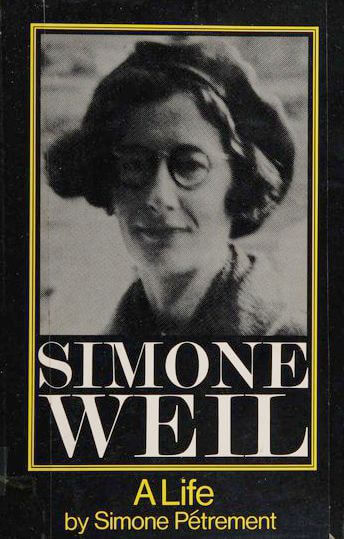
It seems that the sublime French thinker and searing mystic, Simone Weil, is once again very much with us. She died at the age of 34 in 1943 in Ashford, Kent, but her spirit haunts us still.
It isn’t unexpected that there would be a revival of interest in her life and work at the moment, given that much has been made of the publication of her letters in 2024. After all, our current geopolitical reality with its rise of totalitarianism and the eclipse of the free sovereignties provides the perfect climate for a resurgence of interest in that intentional labourer the French called the Red Virgin, the consummate and intrepid foe of every iteration of Fascism.
And so I wasn’t surprised to see that she has a prominent place in the latest work by historian Timothy Snyder. In On Freedom, Snyder was inspired by Weil’s grasp of what human freedom actually means with its deep communal dimension—“Simone Weil said that everything precious in us comes from others, not as a gift but as a ‘loan that must be constantly renewed’”—and in doing so he recognized in Weil an antidote to the muscular collectivism of the tyrannies and the degraded individualism of the liberal democracies that define our current political landscape.
But it was while reading the brilliantly constructed and poignant telling of a distant rape and its enduring aftershocks—Sarah Beckwith’s “By the Canal” in the June 2 issue of The New Yorker—that I realized that Weil had returned to public awareness in new, relevant and endlessly inventive ways.
Beckwith wrote: “In the summer of 2024, troubled by the memory of my rape [the rape occurred in East End London in 1984] I turned to the work of Simone Weil. . . .Weil’s invocation of evil exactly identifies a major part of the moral harm of rape: ‘When harm is done to a man, real evil enters into him; not merely pain and suffering, but the actual horror of evil.’ Of course I wanted to add (to cry out), ‘When harm is done to a woman, real evil enters into her … the actual horror of evil.’ Out of an evil encounter, I starved for the good, and when I found it articulated in Weil’s work I thought it beautiful.”
With Snyder, Weil is a profound thinker who makes sense of the current madness of our political fracturing, and with Beckwith she is a moral and spiritual voice of healing in the context of personal trauma.
But who is she and why has she returned now specifically?
And now it gets personal.
It was 1971 and I was walking in a wooded area near Toronto’s York University when Timothy Brownlow, a fellow doctoral student and future John Clare expert, told me that the only figure in Christianity who truly kept him connected with religion was Simone Weil.
I had never heard of her.
But then she began to insinuate her way into my life—intellectually and spiritually—in ways that seemed contrived to bring me into a robust conversation with her legacy. We became seriously acquainted first through her appearance in the diaries and essays of the Trappist monk and poet Thomas Merton, the subject of my doctoral dissertation.
Merton observed that she was a question mark, “questioning not Christ, but Christians.” Not unlike Merton’s own vocation, I thought. Another connection, Jungian in its symmetry, is the realization on Merton’s part that the physician who signed Weil’s death certificate attributing the cause of her death to “myocardial degeneration and pulmonary tuberculosis … by refusing to eat while the balance of her mind was disturbed” was his godfather and guardian Tom Bennett. Merton wryly notes: “funny that she and I have this in common! We were both problems to this good man.”
But it wasn’t the Merton connection that solidified my interest in a religious luminary, political activist and social philosopher who once said of herself that she was “the colour of dead leaves, like certain insects which go unnoticed.” There are few figures in modern history less likely to go unnoticed than Simone Weil and I wanted to know why.
I wanted to know why Merton’s contemporary, the Southern Gothic Catholic novelist Flannery O’Connor, saw Weil’s life as that of an “angular intellectual, proud woman, approaching God inch by inch with ground teeth” and I wanted to know why Susan Sontag would write of Weil that she is “best likened to Nietzsche and Kierkegaard for the scathing originality of her personal authority.” And I wanted to know in ways unlimited by text and canon.
This is where the Canadian Broadcasting Corporation (CBC) providentially arrives on the scene: I was commissioned in 1982 to research, interview, and narrate a four-hour radio documentary on its prestigious intellectual affairs program, Ideas, focusing on the life and thought of Weil. The series first aired in 1984 as Simone Weil: The Afflicted Genius of France and I relished every moment I spent with the still-surviving members of Weil’s inner circle.
I interviewed Gilbert Kahn, a classmate and associate of Weil’s dating back to their years at the Lycée Henri-IV in Paris, in his apartment directly across from the Palace of Versailles. His affection for Weil was enduring. He saw in his fiery friend an unbending opposition to the tyranny of technology, the mad obsessions of totalizing governments, the ugly caress of anonymity. She fought the principalities of the world on the ground: as a champion of the Left, a teacher, a factory worker, a campaigner.
And yet, for all her brilliance and passion as a political thinker and activist, she never quite fit in. Why would the daughter of a successful physician throw in her lot with the exploited? Why would a stellar graduate of the École normale supérieure long for identification with the broken and why would a child of privilege seek acceptance among the dispossessed? These questions for Kahn were best answered when he perceived a shift in her thinking from a philosophy of freedom to a philosophy of obedience:
“For Simone, salvation can only come through the renunciation of the self, through an attitude of patient waiting on God. Clearly her position changed because she saw the good, and no longer freedom, as of ultimate importance to her. To be a slave of the good was preferable to free action.”
On one occasion, during her time as a trade unionist, she self-identified with the unemployed section in the southern French town of Le Puy-en-Velay where she worked at a bourgeois academy for girls. This political activity on her part was judged seriously indiscreet, and she was transferred by the Minister of Education to Auxerre where she defiantly continued her writing, protesting and public identification with unemployed workers. The Headmistress at the Auxerre lycée abolished the philosophy class.
Throughout her chronologically concentrated history of struggle against the dominant powers of oppression, Weil drew extensively on the values and spirit of that epitome of civilization: the Greeks. They provided her with a metaphysical critique of society, a critique that was full of admiration, idiosyncratic, bursting with creativity and electric insight in spite of its restricting partiality.
Her friend Gustave Thibon recognized her attachment to Hellenism for what it was: contempt for all forms of fascism grounded in her Platonic loathing for the collectivity. Close to her in her final days in France, Thibon grasped quicker the consequences of her absolutist convictions, opinions that admitted little in the way of nuance and betrayed her intolerance to contrary perspectives.
In the tradition of French intellectuals who exist outside the academy—Thibon was a conservative Catholic philosopher and writer who lived his long life on his farm estate in Saint-Marcel-d’Ardèche—the grand seigneur met me at the local train stop on the Marseilles line. He carried a copy of Weil’s L’Enracinement (The Need for Roots: prelude towards a declaration of duties towards humankind) so I would recognize him, and we began a conversation, laboured at times because of his poor English and my indifferent French, but always animated by his deep affection for Weil.
He felt her categorical embrace of all that is Hellenistic as pure and perfect but too comprehensive in its scope. He also found her unqualified denunciation of the Hebraic tradition for its emphasis on exclusivity as dangerously blinkered, especially in a time of Jewish persecution by the Third Reich.
But it was Rome that incurred her special wrath. Enmeshed in the structures and psyche of power, she saw the church as the inheritor of all that was wrong with the Roman empire, spirit-crushing, hegemonic, dogmatic bolstered by its simple sentence of terror: anathema sit.
But as always with Weil her absolutism was mitigated by her visceral experience. Thibon spoke to me movingly of a mystical moment Weil had while staying on his farm: “One day she told me she had a revelation of Christ’s divinity and it took place right over there about a metre or two from where you and I are sitting. She said to me that if you were to ask her what faith she had she would speak of the sacraments, the liturgy, the mysticism, all these components of the Roman church but if you were to ask her if she adhered to all the pronouncements of the Council of Trent that religion was not hers.”
I suspect she would not be alone in that.
In the end, it is not Weil’s theology that is currently in revival; it is not her ever-altering attachment to always disappointing political ideologies, nor her Hellenism. Rather, it is her radical empathy with the suffering, her refusal to comply with empty conventions of thought and practice, her steely opposition to the monsters of power.
Novelist André Gide called her the saint of the outsiders. In our new age of totalitarianism and collectivist hostility to the good, she has become the saint of the resisters.
Michael Higgins, Toronto, ON