
Eileen Little: 1926-2025 R.I.P.
Phil Little, Nanaimo, BC
Volume 40 Issue 4, 5 & 6 | Posted: July 27, 2025
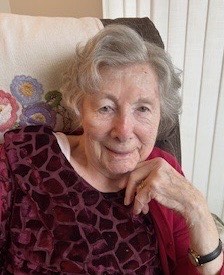
On April 17, 2025 Eileen Little finished her earthly journey, just shy of 99 years. Born Margaret Eileen Clarke in 1926 in the ancient town of Wakefield, Yorkshire mom lived a full life and was gifted with a keen mind almost until the end of her life. In her final years living in a senior retirement home, mom was physically shrinking while maintaining a super keen memory and an interest in current events.
Mom always had a sense of history, for that was part of her English heritage. Looking at rare old photos mom could identify children in her elementary school photos, usually from some event such as first communion, and she could name the boys and girls and detail on what streets they lived on in relation to her own home which was called Waite House on Flanshaw Lane.
As the only daughter and oldest of three children, mom grew up in a family that had its own peculiarities, what we today would call dysfunctions. Her father coming from poor Irish roots established himself as a successful businessman in the Ironmonger trade. Grandma Annie was also of poor Irish origin, and at the age of 8 years she worked in a woollen mill from dawn to dusk. Marrying an upcoming Irish Catholic man gave her a jump in class, something important to the British.
As a successful businessman Grandpa Harry Clarke sent both sons after their elementary years to the private Jesuit school. Mom did not get the same advantage for she was after all ‘only a girl’ and education for her was not valued. She did attend for some time an “art school” which she enjoyed where perhaps her artistic side began to bloom.
Then came the war, virtually to rob her of her youth. At 16 she was in the Junior Air Cadets and at 17 she enlisted with the W.A.A.F., the women’s wing of the R.A.F. Mom wanted to drive a truck, but she was assigned to work as an auxiliary nurse at different bases receiving the wounded from the battles on the continent. Much of her time was working in the amputation section, dealing with broken men coming back in pieces.
In December 1944 at a social gathering in an air hanger, mom met a Canadian airman. On Valentine’s Day 1945 my dad, Ernie Little, proposed to mom and gave her a ring that was bought at Birk’s in Calgary and sent to dad by his sister Mary. Mom had no experience with men, she went from an isolated Irish Catholic home to the air force where she lived under military control. At the age of 18, mom married in June 1945 for which dad was granted leave for only a few days, which included a few days honeymoon in Scarborough. Then dad returned as part of the invasion force working through Holland, Belgium and Germany. Mom returned to her hospital posting.
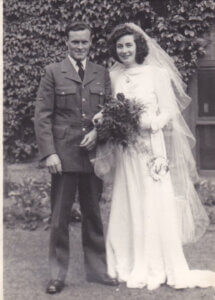
Dad, like many servicemen, didn’t use his real name, he called himself “Jimmy” and he misrepresented his status. He told mom that he had a ranch in Alberta and raised “gophers”. Not knowing what these little rodents were, to mom it sounded impressive. My grandmother who was very class conscious promoted dad to “veterinarian” among her friends until one day when dad burst that bubble. They were in love and they survived the war. Dad was shipped home but not totally decommissioned.
Left behind were 48,000 “war brides” and over 20,000 children who with marriage became automatic Canadian citizens who needed to be brought over. Mom sailed on a ship called the “Lady Rodney” which to the women seemed like a cruise ship serving delicacies such as fresh fruit, unknown during the war. They were travelling to the promised land. For many war brides this new life was more than a bitter disappointment and some endured harsh conditions and abuse.
My dad did not have a gopher ranch, in fact he lived on a very poor ¼ section farm that belonged to his parents located near Drumheller. His dream was to have his own farm but he had no means to buy land. The Air Force sent him to southern Alberta to apprentice as an automobile mechanic. Mom arrived in Calgary on May 1946 at the age of 19 and went to live in the little town of Beiseker, a surprise to mom coming from the war and learning that she would be living in a German village where many women still spoke German. Dad was apprenticed at the one local garage operated by the Schmaltz family.
They rented a “house” from the Schmaltz group that was very small and without insulation. It was heated with a potbelly stove which also served for cooking. There was an outhouse a short walk behind the house for which she had to shovel a path through the snow in the winter. In England her home was one of the few with indoor plumbing, because of her father’s trade as an Ironmonger. In every aspect, life in Beiseker was a downhill spiral.
Here was a young woman with a strong Yorkshire accent, who loved to read books and listen to classical music or walk in the park on weekends. In Beiseker there were no parks, no classical music and the main reading came with the Eaton’s catalogue. On top of that mom experienced outright hostility because there was a feeling that the war brides “took advantage” of the men who went to war and also deprived the women who were waiting for them back home.
My grandmother (of Irish background) bluntly stated that she thought the English done’t know how to keep a clean home. My mom was totally out of her element and in unfriendly territory.
Within a month she was also pregnant, living alone in a house barely above the status of “shack”, her husband travelling to southern Alberta for his courses while mom was trying to learn to do things on her own, for the first time in her life. She couldn’t turn around because the last thing her father said to her when he took her to the train in Yorkshire was “you’ve made your decisions, don’t be coming home”.
In that first month her sister-in-law Mary, married to the local barber, took mom to her first C.W.L. (Catholic Women’s League) meeting which became for mom a lifeline to sanity. Mom was able to pay her first dues and became a lifelong member for 79 years. After a year in Beiseker dad found employment at a Ford dealership in Calgary and he began building their first home on 24th Avenue NW where the city ended and the prairie began.
Their first church was St. Joseph’s parish and mom immediately integrated in the community C.W.L. where she met some women who provided her with support, encouragement and mentoring. Ernie came from a pious Catholic family where the mother was the defender of the faith and somewhat tyrannical in her religiosity, so like an older brother he probably would have left the church. By chance he fell in love with and married a catholic woman and so parish life remained a strong aspect of their marriage and family life.
As Calgary grew, another parish, St. Pius X, was formed and mom was a founding member of the new CWL group. The CWL was more than a religious group, it was mom’s main and only social outlet. Children arrived in succession, even when mom’s health was frail and she was even warned that a future pregnancy could kill her. However, the power of the church was such that permission to use birth control was refused by the parish priest. So each pregnancy was an imminent threat and a reminder that for the church the welfare of the woman was a far distant second priority to maintaining church made regulations.
In 1962 the family was uprooted to live in Edmonton because dad was given a promotion as a garage foreman working for AGT (now TELUS). Mom had to leave behind her new home and the community where she had become established. She had no choice as a good catholic wife. The family landed again in a new parish run by the Oblate Fathers, who were also present in the Catholic High school. There was a new CWL being formed and mom started again, now as a CWL veteran and she became CWL president.
Mom was involved in various charities, most connected to the church, and then even as mother of 9 children she took in fostering indigenous children at the urging of Catholic family charities. While this today is referred to negatively as the “60’s scoop”, mom and dad responded generously to the appeal from the Church representatives to assist indigenous children in need. One child was a day old baby of a woman from the Tlicho Dene (Dogrib) tribe in Northern Alberta who had come to Edmonton with tuberculosis. The baby stayed with them for more than a year and losing the child broke my parent’s heart. In 1977 mom was proclaimed “Mother of the Year” by the city of Edmonton and she was honoured in the festive Klondike Days parade.
Mom was again established, she had a new home that was not being built over her head. She was a respected leader in the Catholic community, President of the CWL, a presenter in marriage preparation courses organized by the diocese promoting the Billing’s method of family planning, a foster mother, and honoured citizen of the city. Mom and Dad who had little fun time in their life even had joined a private social club which featured socials and “curling” teams.
It all came crashing down when dad found a small advertisement for a 20 acre farm on Vancouver Island. Having his own farm was my father’s dream, but always beyond his means. They flew out to Vancouver Island, saw the farm in Cedar with a dilapidated farm house used by a hippie community. My father saw endless projects and possibilities and my mother wept. Of course she followed her husband, that was the way for Catholic women and this war bride found her “ranch”, not quite what she envisioned in 1945.
St. Peter’s Catholic parish had a very progressive parish priest and an active CWL. Again the CWL became her base to rebuild and re-establish herself. Mom put on a brave face and adapted. She took photos holding chickens and smiling, and she dedicated herself to her garden with marvellous floral displays. The parish priest was decades ahead of the local bishop De Roo who was considered to be progressive. Fr. Jack Sproule was into “synodality” before it became defined decades later. Jack wanted to be pastor and he delegated almost every task to a willing parish council who took over the parish. Mom and dad became very excited and active in many functions of the parish, and were called “ministers” to the community. Mom was called to be part of a woman’s advisory council for the diocese assisting the bishop. Mom was supported and again mentored by strong and prophetic women, some from the Bethlehem retreat center and the prophetic Sister Margaret Rowe. Mom was active with other women’s circles not connected to religious cultures.
In this time mom began to voice a critical review of her own life, as she could look back and marvel at her own survival and growth. Mom valued her CWL roots, and began to understand her own growth as a Catholic woman from second class lay woman to leader with a recognized voice. In her early years the CWL was used as a fundraiser for the clergy, and was never sure that the money raised ever went to the church. In Nanaimo Fr. Jack called his parishioners to become responsible for themselves and for their parish. They began to feel like adults in their church.
Good things are not always meant to last. The bishop transferred Fr. Jack to a parish in Sidney and Nanaimo ended up with a series of clergy who did not appreciate lay involvement and certainly not sharing responsibilities. Many if not most of the active parish council people drifted away from the parish, some gathering in small faith communities like Charismatic circles. People who were treated and respected as responsible members were not able to go back to the “pray, pay and obey” mode of membership.
With Ernie’s declining health and death in 2010 mom was able to sell the farm and begin to live independently in Nanaimo renting in different facilities, and was able almost to her final month to maintain some semblance of independence. Mom outlived many of the women who had been part of her great period of growth and maturity as a Catholic woman, nurtured by a shared reading of serious theological and feminist authors.
Phil Little, Nanaimo, BC